
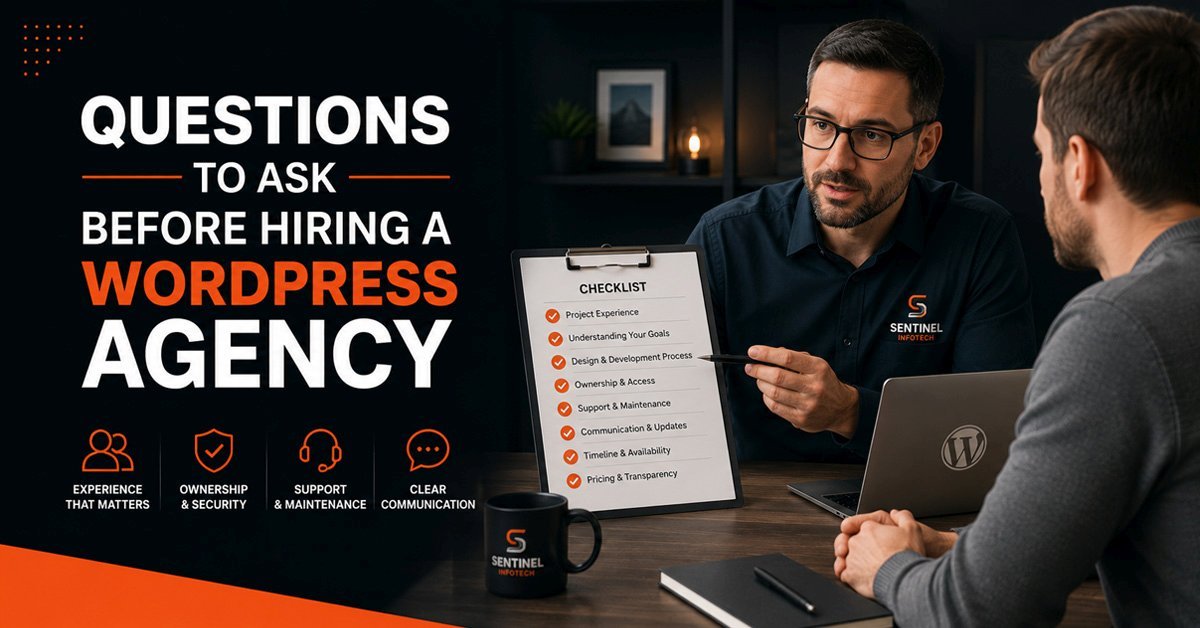
The questions that matter most before hiring a WordPress agency are not about the technology at all. They are about what happens after launch: who owns the site, how fast problems get fixed, what the agency does when something goes wrong, and whether you will still be able to reach them a year from now. Ask about hosting, backups, code ownership, communication style, and post-launch support before you ask anything about design.
At Sentinel Infotech we have been building WordPress and WooCommerce sites since 2009, and a good portion of our new client conversations start the same way. The business had a previous developer, sometimes a freelancer, sometimes a small agency, and the relationship ended badly. Not because the site looked wrong at launch, but because something broke six months in and nobody picked up the phone. This post is written from that pattern, not from a generic vendor checklist.
If you are still deciding whether an agency is the right choice for your project, our comparison of WordPress agencies vs freelancers covers the specific factors that determine which option fits your situation.
Why This Decision Is Harder Than It Looks
Choosing a WordPress agency looks like choosing a vendor. In practice it is closer to choosing a long-term technical partner, because a website is not a one-time deliverable. It needs updates, it needs fixes when plugins conflict with each other, it needs someone who understands why it was built the way it was built when a change is requested two years later.
The difficulty is that most of what separates a good agency from a mediocre one is invisible at the proposal stage. Two agencies can show similar portfolios, quote similar prices, and say almost identical things on a discovery call. The difference shows up in the code quality nobody outside the project can see, in how the agency responds when a deadline slips, and in whether the site is still theirs to maintain freely a year after handover or quietly locked to one developer who built it in a way only he understands.
These questions exist to surface that difference before the contract is signed, not after.
Questions About Technical Approach
Do you build with a page builder, a theme framework, or custom code? There is no single correct answer here, but the answer should match the complexity of what you are building. A simple brochure site built entirely in a page builder is reasonable. A business-critical WooCommerce store or a site with custom functionality built the same way often means slower load times and a site that is harder to extend later. Ask the agency to explain why they chose their approach for a project similar to yours, not just what the approach is.
How do you handle plugin selection? WordPress sites accumulate plugins quickly, and every plugin is a dependency that needs updating and can conflict with others. An agency that can explain why they chose a specific plugin over alternatives, and that keeps the plugin count deliberately lean, is thinking about the site's long-term stability. An agency that reaches for a new plugin every time a feature is requested is building a site that will become fragile.
Will the site be built on a page builder I can also edit myself? If part of the value you want from this relationship is being able to update content yourself, confirm the site will actually support that. Some custom-coded approaches produce sites that look identical to page-builder sites but require a developer for even small text changes. Neither approach is wrong, but you should know which one you are getting.
How do you approach site speed and performance? Ask what a typical PageSpeed score looks like for their recent projects, and ask what specifically they do to keep sites fast. A generic answer about caching plugins is a weaker signal than a specific answer about image optimization, hosting configuration, and code discipline. Our post on WordPress technical SEO fixes covers many of the performance issues that separate fast sites from slow ones.
Questions About Ownership and Access
This is the category most businesses skip and most regret skipping later. A website you do not fully own is a website you are renting from your developer, whether or not that was ever stated out loud.
Questions About Support and What Happens After Launch
Launch day is the easiest part of a website project to get right. What happens in month eight, when a plugin update breaks a page or a client reports the contact form has stopped sending emails, is where the real difference between agencies shows up.
What is included after launch, and for how long? Some agencies include thirty days of free bug fixes and nothing after. Others offer ongoing maintenance plans. Neither is wrong, but you need to know which one you are getting and what it costs once the included period ends. Our post on what a WordPress maintenance plan actually covers is a useful reference for evaluating what should be included.
How quickly do you respond when something breaks? Ask for a specific response time commitment, not a general assurance of being responsive. A site that is down for six hours during business hours has a real cost. Know what response time you are actually being promised.
What happens if my site gets hacked? Every WordPress site is a target eventually. Ask what the agency's process looks like if it happens: do they have a cleanup process, is it included in a support plan, and how do they prevent recurrence. Our post on what actually gets WordPress sites hacked covers the vulnerabilities that a competent agency should already be guarding against by default.
Who do I actually talk to when I have a problem? In a small agency, this might be the founder directly. In a larger agency, it might be a support ticket queue. Neither is automatically better, but you should know which one you are signing up for and whether that matches how urgently you expect problems to be handled.
Questions About Process and Communication
How will you keep me updated during the build? A weekly update, a shared project board, or scheduled check-in calls are all reasonable answers. No answer, or a vague promise to "stay in touch," usually means updates will arrive only when you chase them.
What do you need from me, and when? Website projects slow down most often because the client has not delivered content, images, or feedback on time, not because the developer is behind. An agency that tells you upfront exactly what they need from you and when is setting the project up to actually hit its timeline.
Can I see the site before it goes live? The site should be built and reviewable on a staging environment before it replaces your existing live site or goes live for the first time. This gives you a real chance to request changes while they are still inexpensive to make.
What happens if the timeline slips? Timelines slip on a meaningful share of real projects, often for reasons outside anyone's control. An agency that acknowledges this honestly and explains how they communicate delays is more trustworthy than one that promises a guarantee no project can actually make.
| Question Area | Strong Answer | Warning Sign |
|---|---|---|
| Hosting ownership | Hosting account is registered in your name from day one | Agency insists on hosting everything under their own account with no explanation |
| Admin access | You get full admin login during the build, not after final payment | Access is withheld until the invoice is settled |
| Support after launch | Specific response time and clear scope of what is included | Vague reassurance with no specifics or timeframe |
| Leaving the agency | Direct, unhesitating yes, with an explanation of how handover works | Hesitation, deflection, or discouragement from asking |
| Plugin approach | Can explain why each plugin was chosen and keeps the count lean | Adds a new plugin for every small feature request |
| Project communication | Specific update cadence, shared project visibility | General promise to "stay in touch" with no structure |
Use Cases: What This Looks Like in Practice
When You Do Not Need to Ask All of This
Not every project justifies the full checklist. If you need a simple one-page site with no ongoing content updates, no ecommerce, and a modest budget, some of these questions add more friction than value. A freelancer or a small studio delivering a straightforward landing page does not need to be evaluated with the same rigor as an agency building a multi-vendor WooCommerce store or a client portal that your business will depend on daily.
The depth of vetting should scale with what is actually at stake. A site that generates revenue, holds customer data, or will need ongoing changes for years deserves the full set of questions above. A simple informational site with a five-year lifespan and no real complexity does not need the same level of scrutiny, though ownership and access questions are worth asking regardless of project size.
How We Answer These Questions Ourselves
We would rather a prospective client ask us every question on this list than sign a contract on trust alone. Hosting and domain accounts go in the client's name from the start. Admin access is granted during the build, not after final payment. Support scope and response expectations are agreed before the project starts, not discovered afterward. If a client ever wants to move to another developer, that is their decision to make freely, and we will hand over a documented, organized site that makes the transition straightforward.
You can see how this plays out in practice on our WordPress development service page, or in how we approach ongoing care on our WordPress maintenance checklist, which is the same checklist we run against sites we did not originally build.
Frequently Asked Questions
How many WordPress agencies should I talk to before deciding?
Three conversations is usually enough to notice patterns. Talking to only one agency gives you no comparison point for pricing, communication style, or how confidently they answer the ownership and support questions above. More than four or five tends to produce decision fatigue without adding much new information, since the same questions start returning similar categories of answers.
Should I choose the agency with the lowest quote?
Not automatically. A significantly lower quote than everyone else is usually explained by one of a few things: less experience, a build process that cuts corners on testing and documentation, or a plan to make up the difference through change requests and support fees later. Price is a legitimate factor, but it should be weighed against the answers to the ownership and support questions, not treated as the deciding factor on its own.
Is it a red flag if an agency cannot answer these questions immediately?
Not needing to answer instantly is normal, especially for less common questions. What matters is whether they follow up with a clear, specific answer afterward, or whether the question gets deflected or forgotten. An agency that takes a day to confirm exact hosting details but comes back with a precise answer is behaving reasonably. One that never circles back, or gives a different vague answer each time it is asked, is showing you how they will handle follow-through after the contract is signed.