
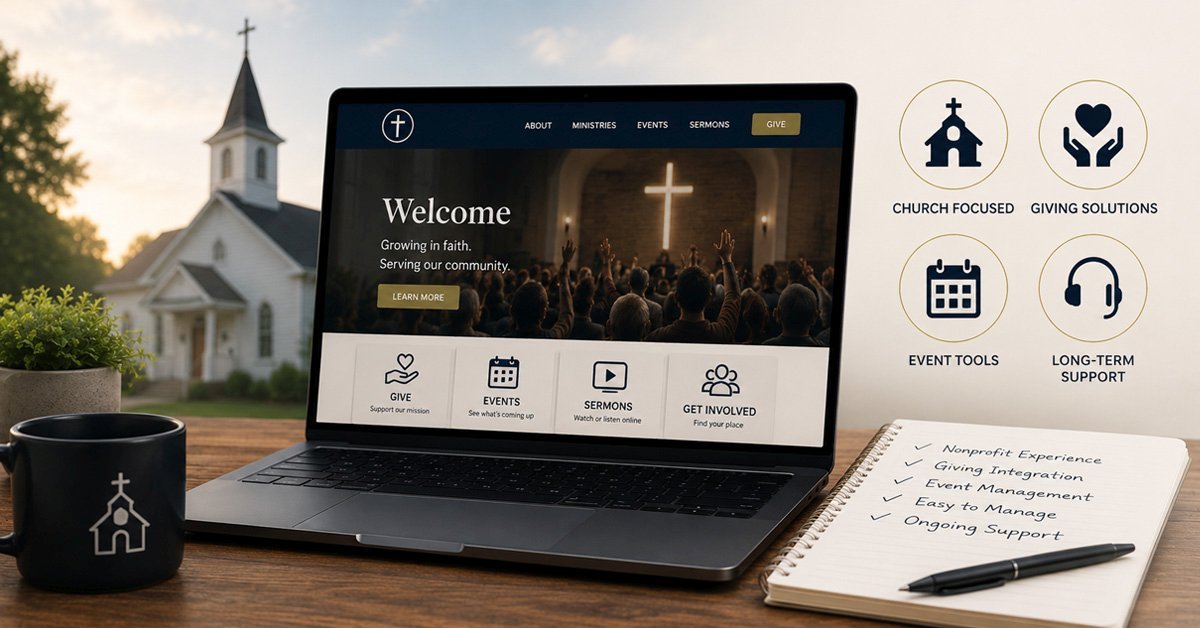
Most WordPress developers can build a church website. Far fewer understand what a church website actually needs to do. That gap is where most church website projects go wrong, not in the technical execution, but in whether the developer understood the organization well enough to build something that genuinely serves it.
At Sentinel Infotech, we have built WordPress websites for churches, ministries, and faith-based nonprofits across multiple regions worldwide. The conversations we have with church administrators before starting a project are consistently different from the conversations we have with business clients. The priorities are different. The definition of success is different. And the things that go wrong when a developer misunderstands a church client are different too.
This post gives church administrators, pastors, and ministry leaders a practical framework for evaluating WordPress developers before hiring one, what to look for, what to ask, and what answers should give you pause.
Why Church Website Projects Require a Different Approach
A church website has requirements that a general web developer may never have encountered. Online giving with recurring donation support and designated fund selection is not standard ecommerce. A sermon archive organized by series, speaker, topic, and scripture reference is not a standard media library. A volunteer management system where coordinators manage rosters and communicate with sign-ups is not a standard contact form.
Beyond the features, the operational context is different. The people managing a church website after launch are often volunteers or administrative staff who have no technical background and limited time. A developer who builds a visually impressive site that requires technical knowledge to update has not served the church well, regardless of how good the site looks at handover.
Budget considerations are also different. Every dollar a church spends on its website is a dollar not spent on ministry, outreach, or community programs. A developer who scopes honestly, recommends what is genuinely needed, and avoids padding a project with unnecessary complexity understands this. One who does not will leave the church with a site that cost more than it should and requires ongoing paid assistance for basic updates.
What to Look For in a WordPress Developer for Your Church
1. Experience With Church or Nonprofit Website Features
Generic WordPress experience and church website experience are not the same thing. A developer who has built business websites for years may have never configured an online giving platform, set up a sermon library with podcast feed generation, or built a volunteer sign-up system with automatic confirmations and roster management.
Ask specifically whether they have built online giving systems, sermon archives, and event registration for churches before. Ask to see examples. If the answer is that they have built similar things for other clients, ask what specifically makes church requirements different from those projects. A developer who has genuinely worked with churches will have a ready answer. One who has not will give you a vague response about WordPress being flexible.
Our church website development page covers the specific systems we build for faith-based organizations in detail, which gives you a reference point for what genuine church website experience should include.
2. Understanding of Non-Technical Staff Requirements
The person who manages your church website after launch is probably not the same person who hired the developer. It might be a church administrator, a volunteer, or a part-time staff member with no WordPress experience. The developer you hire needs to build with that person in mind from the start.
This means the content management interface needs to be genuinely intuitive for non-technical users. Adding a new sermon, updating service times, publishing an event with registration, and managing volunteer sign-ups should all be achievable without training beyond a basic walkthrough. If the developer cannot explain clearly how a non-technical staff member will handle day-to-day updates, that is a warning sign.
Ask specifically: who will be managing this site after launch, and how will you build the admin interface to suit them? A good developer will ask you this question before you ask it of them.
3. Transparent Scoping and Honest Budget Conversations
Church website projects have a way of expanding beyond their original budget when a developer does not scope honestly from the start. Feature creep, vague estimates, and hourly billing without clear boundaries are the mechanisms through which this usually happens.
Look for a developer who gives you a clear scope document before any work begins, specifies exactly what is included and what is not, and uses fixed-price or clearly bounded project pricing rather than open-ended hourly billing. If a developer cannot tell you what the project will cost before starting, that uncertainty will show up on your invoice later.
A developer who genuinely understands nonprofit budget realities will also push back when a feature request is not worth the cost for your size of organization. The honest conversation about what a church of 200 people genuinely needs versus what would be impressive to build is one of the more valuable things a good developer brings to the table.
4. A Plan for Long-Term Maintenance and Support
A WordPress church website is not a one-time project. After launch, it needs regular plugin updates, security monitoring, backups, and performance checks. It also needs a real person to call when something breaks, an event registration form stops working before a major fundraiser, or the sermon upload interface produces an error on a Saturday night.
Ask any developer you are considering what happens after the site goes live. Do they offer ongoing maintenance? What does it include? What is the response time when something is urgent? Is there a separate support contract or is it included in the project? A developer who has no clear answer to post-launch support is a developer who will be hard to reach when you need them.
Our WordPress maintenance service covers churches and nonprofits specifically because faith-based organizations often do not have the technical staff to manage site health themselves and cannot afford downtime around services, events, or giving campaigns.
5. Experience With Online Giving Platforms
Online giving is one of the most operationally significant features a church website can have. Configured correctly, it increases giving frequency and total donation volume because it removes friction for donors who want to give consistently. Configured incorrectly, it creates problems that affect the organization's finances directly.
The requirements for a church giving platform go beyond a standard payment form. Recurring giving support, designated fund selection (general fund, building fund, missions, specific campaigns), donor records and giving history for the finance team, and giving statements for tax purposes are all features that a developer who has only built ecommerce sites may not have configured before.
Ask specifically how they would handle recurring giving with fund designation. Ask how the finance administrator accesses donor records and generates giving statements. If the developer has not built this before, they will learn on your project, which means your budget funds their education.
6. Clarity on Who Actually Does the Work
Some developers take on projects and outsource the actual development to a third party, sometimes to developers the church client never meets. This creates problems with communication, quality control, and post-launch support. When something goes wrong, the developer you hired does not know what the person who actually built the site did, and the person who built it has no relationship with your organization.
Ask directly: will you personally be doing the development work, or will any part of this project be outsourced? If any part is outsourced, who to and what oversight is in place? A developer who cannot answer this question clearly is worth being cautious about.
Questions to Ask a WordPress Developer Before Hiring Them for Your Church
These questions are designed to surface the difference between a developer who genuinely understands church website requirements and one who is confident they can figure it out. Both may be technically capable. Only one has done it before.
Red Flags to Watch For
These are the patterns that consistently appear in church website projects that go badly, based on the conversations we have with church administrators who come to us after a previous developer relationship did not work out.
Vague timelines with no written milestones. A project without a written schedule and defined deliverables is a project that will take longer than expected. For a church that has communicated a new website launch date to its congregation, this is particularly damaging.
No clear ownership of content after handover. Some developers retain control of domain registration, hosting accounts, or plugin licenses in ways that create dependency. Your church should own every account, login, and license associated with its website from day one. Ask for this explicitly before signing.
Enthusiasm about features without questions about operations. A developer who is excited to build an impressive sermon library without asking how many sermons you publish per month, who uploads them, and what metadata staff will realistically maintain has not thought about whether the system will actually be used after launch.
No mention of security or backups. A WordPress website without proper security configuration and a reliable backup system is a risk, particularly for a church that processes online giving. A developer who does not raise this topic is either not thinking about it or assuming someone else will handle it.
What a Good Church WordPress Developer Looks Like in Practice
The developers who serve churches well share a few consistent characteristics regardless of their background or location. They ask more questions than they answer in the first conversation. They push back when a feature request is not worth the cost for the organization's size. They think about the staff volunteer who will be managing the site in two years when deciding how to build the admin interface. And they treat the budget constraint as a design constraint rather than a problem to work around.
They also understand that a church website is not finished when it launches. It is a system that the organization will depend on for services, giving campaigns, event registrations, and community communication. Building it well means building it to be maintained, not just to look impressive at handover.
For the full picture of what a well-built church website includes, our post on what church and ministry websites actually need covers the features and decisions in detail. If you are also evaluating whether to build or redesign, our WordPress development service page covers how we approach the technical side of church and nonprofit projects.
When to Use a Specialist Versus a General WordPress Developer
Not every church website needs a specialist. A small congregation that needs a simple site with service times, a contact form, and a basic events page can be built effectively by any competent WordPress developer. The case for a specialist becomes stronger when the requirements include online giving with recurring donations, a managed sermon library with podcast feeds, volunteer systems with automated notifications, multi-campus architecture, or integrations with existing church management software.
The risk of using a general developer for complex church requirements is not that they cannot build it. It is that they will build it in a way that works at launch but requires ongoing developer involvement for tasks that should be manageable by staff. A sermon library that requires a developer to add episode metadata is a system that will fall behind within months. A giving platform that the finance administrator cannot run reports from without help is a system that creates dependency rather than serving the organization.
Our church and nonprofit website development work is built specifically around avoiding that outcome. Every system we build for a faith-based organization is tested against the question of whether a non-technical staff member or volunteer can manage it without ongoing developer help after a basic walkthrough.
Frequently Asked Questions
How much should a church website cost?
The cost depends entirely on scope. A simple church website with service times, a contact form, basic pages, and an events calendar is a straightforward project. Adding online giving with recurring donations and fund designation, a sermon archive with podcast feed generation, volunteer management, and event registration with automated confirmations increases the scope significantly. The honest answer is that any developer who gives you a price without first understanding your requirements is either guessing or working from a template that may not fit what your congregation actually needs. Ask for a written scope before any price conversation, and be cautious of both very low quotes (which usually mean something important is not included) and very high quotes that cannot be justified against specific features.
Should a church use a church-specific WordPress theme or a custom build?
Church-specific themes can work well for smaller congregations with straightforward requirements. They are faster to deploy and lower cost. The limitations appear when your requirements go beyond what the theme was designed for. Customizing a church theme for complex giving platforms, multi-campus structures, or specific volunteer management workflows often takes as much time as building correctly from the start, without the flexibility of a custom build. For congregations with straightforward needs, a well-configured theme is a practical choice. For organizations with complex requirements, a custom WordPress development approach built around your specific operations will serve better over time.
How long does a church website project typically take?
A simple church website with standard pages and basic functionality typically takes four to eight weeks from signed agreement to launch. A more complex project including online giving integration, sermon library, event registration, and volunteer management typically takes eight to sixteen weeks depending on complexity and how quickly the church can provide content, brand assets, and feedback during the process. The timeline that most often goes wrong is one without a written schedule and defined milestones. Before committing to a developer, ask for a project timeline with specific delivery dates for each phase so expectations are clear on both sides from the start.