
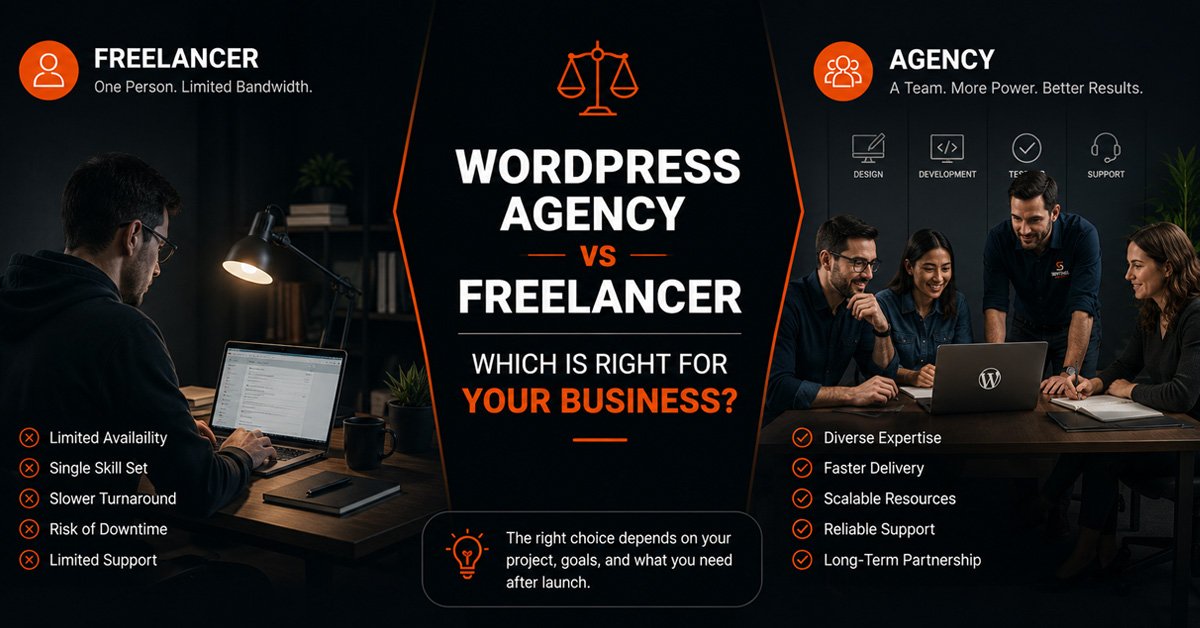
A freelancer is often the right choice for a straightforward WordPress website. A simple brochure site, a personal portfolio, a landing page for a new service, or a small blog with no complex functionality does not need an agency. A skilled freelancer will build it faster, charge less, and do perfectly good work. Hiring an agency for a project like that is paying for capacity and process you will never use.
An agency becomes the right choice when the project involves complexity that exceeds what one person can reliably manage alone, when the site will become operationally important to the business after launch, or when the ongoing support, maintenance, and future development requirements make a long-term relationship the practical reality rather than a nice-to-have.
This post works through the specific factors that determine which option fits your situation. We are an agency, so we have an obvious interest in the outcome of this comparison. We have tried to write it honestly anyway, because a business that hires us when a freelancer would have served them better is not a good client relationship for either party.
What Freelancers Do Well
A skilled WordPress freelancer is a single person with deep expertise who works directly with you, usually charges less than an agency for comparable work, and can be highly efficient on projects that fit within their skill set. There is no overhead, no account management layer, and no internal processes that add time or cost to a project that does not require them.
Freelancers are particularly strong for projects where the scope is well-defined and relatively contained, where the technical requirements are within one person's capability, and where the client relationship benefits from working with the same person throughout the project rather than through an account manager who relays communication to a developer behind the scenes.
- Lower cost for straightforward projects where agency overhead adds nothing
- Direct communication with the person actually building the site
- Faster decisions and fewer process layers on simple builds
- More flexibility on scope and timeline adjustments mid-project
- Personal accountability, one person owns the entire outcome
- Strong option for one-time projects with no ongoing support requirement
- Multiple skill sets available within one engagement, design, development, SEO, integrations
- Business continuity if the primary developer is unavailable
- Structured process for complex projects with many moving parts
- Ongoing maintenance, support, and development after launch
- Accountability at an organizational level, not dependent on one person's availability
- Better fit for projects that will grow and change after launch
What Agencies Do Well
An agency brings multiple people and skill sets to a project. That matters when the project genuinely requires more than one discipline working together: a designer, a developer, someone handling the technical SEO setup, and someone configuring the third-party integrations. A freelancer who is strong in development may be weaker in design. One who is strong in design may not have the technical depth for a complex WooCommerce integration. An agency, in principle, has both.
The other thing agencies bring is continuity. If the freelancer you hire gets sick, takes on another large project, or simply becomes unavailable, your project stops. An agency has team capacity that means one person's unavailability does not stop the work. For a business that depends on the website being live and functional, that continuity has real value.
Agencies also typically have more structured processes for handling complex projects: staging environments, documented handovers, testing protocols, and post-launch support structures. These processes add cost, and for a simple project they add cost without adding proportional value. For a complex project, they reduce the likelihood of things going wrong in ways that cost more to fix than the process would have cost to run.
The Five Factors That Determine the Right Choice
1. Project Complexity
A WordPress website that involves custom plugin development, WooCommerce with complex shipping and payment logic, a client portal with role-based access, integrations with external systems like a CRM or ERP, or multi-site network management is a project where the scope typically exceeds what one person can reliably handle well across all of its dimensions. A straightforward WordPress site with standard pages, a contact form, a blog, and a theme that fits the design requirements is well within a skilled freelancer's capability.
The complexity test is simple: list every distinct technical requirement the project involves. If all of them are clearly within one person's skill set and the list is not overwhelming in volume, a freelancer is a reasonable choice. If the list includes elements in different disciplines or involves a volume of work that would stretch a single person's capacity, an agency is the safer option.
2. Post-Launch Support Requirements
A website that needs ongoing maintenance, regular feature additions, security monitoring, and someone to call when something breaks is a website that needs a stable, ongoing relationship with a developer or team. A freelancer can provide that, but it depends entirely on that specific person remaining available, continuing to do WordPress work, and prioritizing your account over time. Those are reasonable assumptions for a year or two. They become less reliable over a longer relationship.
An agency providing ongoing support has organizational accountability rather than individual accountability. When you contact support, someone responds, regardless of which specific developer is available that week. For a business where the website is operationally important and downtime has a real cost, that reliability is worth paying for. Our post on what a WordPress maintenance plan actually covers goes into detail on what ongoing support should include and how to evaluate what you are actually getting.
The better question is not just what you need today but where your business is likely to be in two or three years. A brochure site that needs no maintenance today can become an ecommerce platform that processes daily orders within eighteen months. A simple contact form site can evolve into a client portal that your operations depend on. Some businesses start with WordPress and later need a custom application built alongside it: an internal dashboard, a customer-facing portal, or a Laravel-backed system that handles workflow the website alone cannot manage. Choosing a developer relationship that can grow with that trajectory, rather than one that fits only today's scope, saves the cost and disruption of changing partners mid-growth.
3. Budget Reality
A freelancer will almost always be less expensive than an agency for equivalent scope, because agencies carry overhead that freelancers do not: staff salaries beyond the developer doing the work, project management, sales, and business operations. That overhead funds the things agencies do well: continuity, multiple skill sets, structured process. If your project does not benefit from those things, you are paying for them without getting value from them.
The budget question is not which option is cheaper in absolute terms. It is which option delivers the best outcome for what you actually need to spend. A freelancer at a lower rate who builds something that needs to be rebuilt in two years is not cheaper than an agency that built it right at a higher rate. A budget that realistically cannot support an agency's rates should inform a decision to find a good freelancer rather than a decision to find the cheapest agency, which usually produces the worst of both worlds.
4. Risk Tolerance
A freelancer is a single point of failure. If they become unavailable for any reason, your project and your ongoing support relationship stops. That risk is manageable for a simple project where the work is contained and the site can operate independently without frequent support. It becomes significant for a complex site that needs active maintenance and development, where a developer disappearing mid-project or mid-relationship creates a real operational problem.
The risk question is: if the person you hire became unavailable six months into the relationship, what would the impact be on your business? If the answer is minimal, a freelancer's single-point-of-failure risk is acceptable. If the answer is significant, an agency's organizational continuity justifies its cost.
5. The Nature of the Relationship You Need
Some clients want to work directly with the person building their site. They value the directness, the lack of intermediary, and the personal relationship with someone who knows their project inside out. That experience is genuinely better with a skilled freelancer than with an agency where the account manager and the developer are different people.
Other clients want a structured relationship with clear responsibilities, documented processes, and organizational accountability. They are buying reliability and process as much as technical skill. That is what an agency provides. Neither preference is wrong. The question is which one describes how you actually want to work.
Honest Situations Where Each Option Is Clearly Right
For businesses that have decided an agency is the right fit and want to understand what custom WordPress development looks like in practice, our custom WordPress development agency service page covers our approach and capabilities.
The Comparison: Agency vs Freelancer Across the Factors That Matter
| Factor | Freelancer | Agency |
|---|---|---|
| Cost for standard projects | Lower, no overhead built into rates | Higher, overhead funds team capacity and process |
| Simple, well-defined projects | Strong fit, no unnecessary complexity | Can be overkill, paying for capacity not needed |
| Complex multi-discipline projects | Stretched across skill sets, weak areas show | Strong fit, multiple skills available within one engagement |
| Post-launch support reliability | Single point of failure if unavailable | Organizational continuity, not dependent on one person |
| Direct communication with builder | Always, one person does everything | Varies, sometimes through account manager |
| Business continuity risk | Higher, one person's availability is everything | Lower, team capacity absorbs individual unavailability |
| Long-term relationship stability | Depends on individual circumstances | Organizational accountability, more predictable over years |
| Flexibility and speed on changes | Often faster, fewer process layers | More structured, can be slower for small changes |
| Revenue-critical sites | Risk of unavailability is too high | Strong fit, responsive support with backup capacity |
| One-time projects, no ongoing needs | Right choice, agency overhead adds nothing | Not the efficient choice for contained, one-time work |
The Hybrid Approach: When It Makes Sense
Some businesses use both. A freelancer for the initial build of a simpler site, then an agency for ongoing maintenance and future development as the site grows in complexity. A freelancer for a contained project alongside an agency relationship for a more complex core platform. This is not a contradiction. It is matching the right resource to the specific requirement at each stage.
The practical challenge with the hybrid approach is handover. A site built by a freelancer that was not documented or structured for maintainability can be difficult for an agency to take over efficiently. The time and cost of understanding a poorly documented site is real, and it falls on whoever takes over. If there is a reasonable chance the ongoing work will eventually go to an agency, it is worth asking a freelancer upfront how they document their work and how they structure sites for handover. The answer is informative either way. Our post on questions to ask before hiring a WordPress agency covers the ownership and handover questions that apply to both freelancers and agencies.
What to Watch Out For with Both Options
With freelancers: The most common problem is not bad work at launch. It is unavailability afterward. A freelancer who built a site and then moved on to other work, changed their rates significantly, or left WordPress development altogether leaves a client with a site that works but has no maintainer who understands it. Ask specifically about their ongoing availability before signing, and make sure you have full admin access and code ownership from day one regardless of how the relationship ends.
With agencies: The most common problem is the gap between who you spoke to during the sales process and who actually builds your site. A senior developer or agency owner who was present on every pre-sales call may not be the person who does the work. Ask who specifically will be working on your project, what their experience level is, and whether the person you spoke with will be involved in the build. An agency that cannot answer this question clearly is one where the answer matters.
With both: The questions about ownership, access, and portability matter regardless of which option you choose. You should own your domain, your hosting account, and your code. You should have full admin access during the build. You should be able to take the site to another developer without the current one's cooperation. These are not agency-specific questions. They are questions for any WordPress developer before any project starts. Our post on what to ask before hiring a WordPress developer covers this in detail for both scenarios.
When Neither Option Is Clearly Better
There is a genuine grey area where either could work: a moderately complex site with some ongoing support needs but not a critical operational dependency, a budget that is in the overlap zone between freelancer and agency pricing, and a project that is not so complex that a skilled freelancer would be stretched but not so simple that an agency's overhead is obviously wasteful.
In that grey area, the decision often comes down to which specific individual or team you find most confidence in. A highly capable freelancer with a strong track record and clear documentation practices is often a better choice than a mediocre agency, and a well-run agency with a clear process and honest communication is often a better choice than a freelancer with vague answers to the ownership and support questions.
The quality of the specific person or team you are talking to matters more than the structural category they fall into. Use the factors above to narrow down which type of engagement fits your project, then evaluate the specific candidates within that category on the things that actually predict good outcomes: their track record on similar projects, their clarity on ownership and access, their honesty about what they can and cannot do, and their transparency about post-launch support.
Frequently Asked Questions
Is a WordPress agency always more expensive than a freelancer?
For equivalent scope, yes, typically. Agencies carry overhead that freelancers do not: multiple staff, project management, business operations, and the processes that make an organization function. That overhead is reflected in rates. However, the comparison is not always straightforward. A highly experienced freelancer with a strong reputation may charge rates comparable to a mid-size agency. A larger agency working on a project outside their specialty may be less efficient than a freelancer who does that type of work every day. The useful comparison is value for cost, not cost alone. An agency that delivers a well-built, documented, maintainable site with reliable ongoing support may cost more upfront but less over three years than a freelancer build that needs to be redone because support disappeared. Evaluate the total cost over the expected life of the relationship, not the day-one project quote.
Can a freelancer provide ongoing maintenance and support?
Yes, and many do it well. A freelancer with a stable client base and a structured maintenance offering can provide reliable ongoing support for years. The risk is not that freelancers are inherently unreliable at maintenance. The risk is that the ongoing support depends entirely on that one person's continued availability, pricing, and focus on WordPress work over time. A freelancer who moves on to a different type of work, significantly raises their rates, or becomes overwhelmed with other projects may not be available when you need them most. That risk is manageable for a site where a gap in support is inconvenient but not critical. For sites where support availability has a direct business impact, the organizational continuity of an agency is worth the additional cost. Our post on what a WordPress maintenance plan covers gives you a framework for evaluating what adequate ongoing support looks like regardless of who provides it.
What should I ask a freelancer before hiring them, the same way I would ask an agency?
The ownership and access questions matter as much with a freelancer as with an agency, sometimes more. Confirm that your domain and hosting accounts are in your name from day one. Confirm that you will have full admin access during the build, not after final payment. Ask explicitly whether you can take the site to another developer if needed, and what the handover would look like. Ask how they handle support after launch: are they available on a retainer, on an ad-hoc basis, or does support end at launch? Ask what happens if they are unavailable for an extended period. These questions are not adversarial. A good freelancer will answer them directly and without defensiveness. Hesitation or vagueness on any of them is the same warning sign it would be from an agency. Our full checklist of questions to ask before hiring a WordPress developer applies to freelancers and agencies equally, with a few adjustments for the single-person context.
Not Sure Whether an Agency or Freelancer Is Right for Your Project?
Tell us what you are building and we will give you an honest answer, including whether a freelancer would serve you better for what you actually need.