
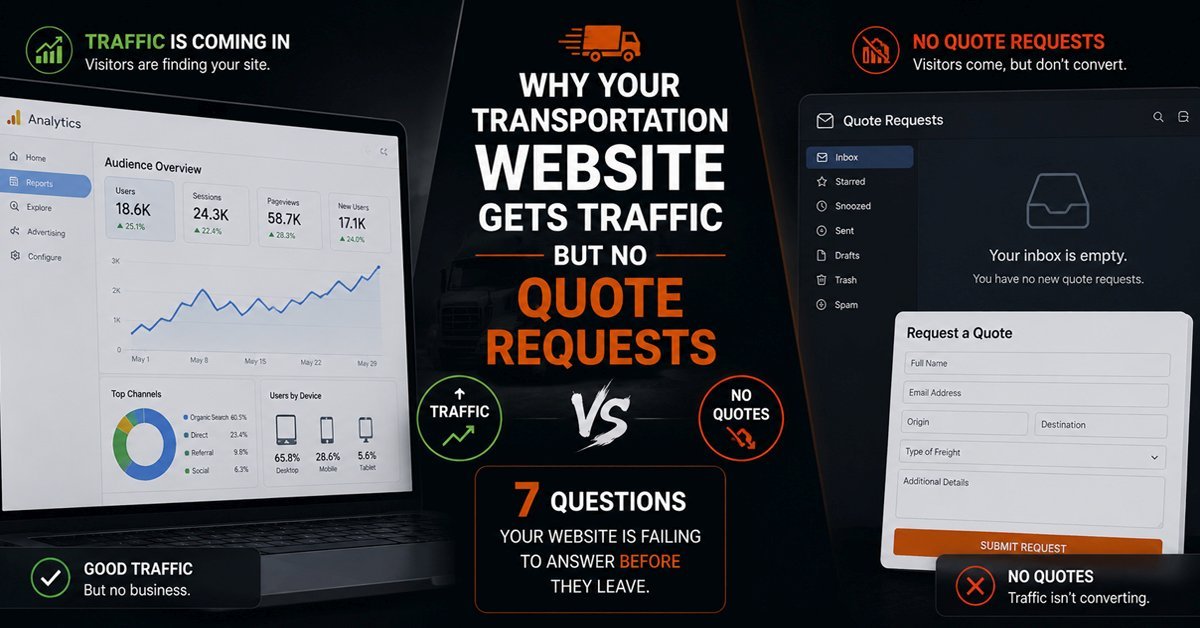
A transportation website that attracts visitors but generates no quote requests has a specific kind of problem: the website is being found but it is not giving visitors enough to act on. The site looks like a transportation business. It does not function like one that earns trust and makes the next step obvious.
When we audit transportation websites before a rebuild, the pattern is consistent. The site has a homepage, a services list, some photos, and a contact form. What it does not have is clear answers to the questions a shipper or freight client is silently asking while they are on the page. When those questions go unanswered, the visitor leaves. Not because they are not interested. Because the website did not give them enough confidence to reach out.
These are the seven questions every shipper needs answered before requesting a freight quote, and the specific ways transportation websites fail to answer them.
The 7 Questions Every Shipper Needs Answered Before Requesting a Quote
A shipper with a specific freight type, temperature-controlled loads, flatbed-only cargo, hazmat materials, or oversized equipment, is not looking for a generic carrier. They are looking for confirmation that this carrier understands and handles what they need to move. If your website leads with "reliable transportation solutions" without stating what you actually transport, that shipper has no reason to read further.
The website is not answering this question when the homepage hero is built around your brand identity rather than your freight capability. A headline that says what you carry and for whom answers the question immediately. A headline that describes your values does not.
Service area is the first thing many shippers check after confirming freight type. A carrier who handles the right freight but cannot confirm they operate the required lane is not a viable option, regardless of how good the rest of the website is. If the coverage area requires digging through an about page or calling the office to confirm, most shippers will not do that. They will move to the next search result.
The most common website failure here is a service area mentioned once in passing, in a paragraph about company history, with no dedicated coverage pages and no lane-specific information. A shipper searching for capacity between two specific cities finds a homepage that says "serving the continental US" with nothing more specific. That is not enough information to justify a quote request.
A shipper evaluating a new carrier needs to confirm basic compliance before they can proceed. DOT authority, MC number, safety ratings, and insurance levels are not supplementary details. They are qualifying requirements. A website that makes a shipper request this information by email or phone has created friction at exactly the moment the shipper is trying to decide whether to proceed.
The problem is almost never that the carrier lacks these credentials. It is that the website does not display them where a shipper would look. Credentials buried in a footer, accessible only on a dedicated compliance page, or simply absent from the website entirely all produce the same outcome: the shipper cannot confirm the carrier is qualified without additional effort they are unlikely to make.
A shipper with specific equipment requirements, a particular trailer type, weight capacity, or temperature range, will not request a quote from a carrier whose website does not confirm the equipment exists. Requesting a quote only to receive a response asking what equipment is needed wastes both parties' time and signals that the carrier's website is not built around how shippers actually evaluate vendors.
Equipment information presented only as a count ("50-truck fleet") answers a different question than the one being asked. A shipper wants to know the specific types, dimensions, and capabilities of that fleet. A website that says "50 trucks" without specifying dry van, flatbed, reefer, or tanker has told the shipper almost nothing about whether their load can be moved.
Compliance credentials confirm a carrier is authorized to operate. They do not confirm the carrier has experience with a specific freight type, industry, or handling requirement. A shipper moving pharmaceutical products, automotive parts, or food-grade cargo wants evidence of relevant experience, not just a safety rating. When a transportation website has no industry pages, no case examples, and no evidence of sector-specific experience, shippers who need that reassurance will not find it.
This is particularly visible in specialized freight. A carrier that handles hazmat regularly has a completely different operational setup than one that handles standard dry van. A website that does not reflect that specialization cannot communicate it to a shipper who needs it.
A shipper who has answered questions one through five and decided to proceed should encounter the simplest possible path to requesting a rate. A generic contact form with a message field does the opposite. It puts the burden on the shipper to structure their own request, provides no guidance on what information to include, and gives no indication of when they will receive a response. Many shippers who reach this point and find a generic form decide the friction is not worth it and move on.
The form itself is a signal. A structured freight inquiry form that asks for origin, destination, freight type, equipment needed, weight, and pickup timeline tells the shipper that this carrier understands what information is needed for a quote. A generic "leave us a message" form tells them the opposite.
A shipper who has confirmed that multiple carriers can technically handle their freight will make a final choice based on differentiation. What makes this carrier the better option? Most transportation websites respond to this question with the same generic claims: "reliable," "experienced," "customer-focused." Those descriptors appear on every carrier's website and differentiate no one.
Differentiation on a transportation website comes from specifics that generic claims cannot replicate: an on-time delivery rate, a specific safety record, a client portal that gives shippers real-time visibility into their freight, a dedicated account manager structure, or a specialization in a freight type that not every carrier handles. When none of these specifics appear on the website, the shipper has no basis for choosing one carrier over another except price, which is the worst possible basis for a business relationship.
The Real Pattern Behind Unanswered Questions
Working through these seven questions on any transportation website usually reveals a consistent underlying issue: the site was built to present the business, not to serve the visitor's decision process. Every section was written from the inside out, describing what the company does rather than answering what the shipper needs to know. The result is a website that looks complete and professional but leaves a shipper with too many unanswered questions to feel confident enough to reach out.
The fix is not adding more content. It is restructuring what exists around the questions a shipper actually asks, in the order they ask them. A homepage that answers questions one and two immediately, service pages that answer three, four, and five in depth, and a quote form that makes question six effortless gives a shipper everything they need to decide. Question seven is answered throughout, by the specificity and professionalism of everything else.
Websites That Help Shippers Make Decisions vs Websites That Slow Them Down
| Shipper Question | Website That Helps Shippers Decide | Website That Slows Them Down |
|---|---|---|
| Can you move my freight? | Freight types stated in homepage hero with specific language matching how shippers describe cargo | Generic "transportation solutions" headline with no freight-specific information visible above the fold |
| Do you serve my lanes? | Dedicated coverage pages per lane and territory with service details and a direct quote path | Coverage area mentioned once in a paragraph with no dedicated pages and no lane-specific information |
| Are you compliant? | DOT, MC, safety rating, and insurance levels on homepage and service pages where shippers are reading | Credentials absent from the site or buried in a footer that requires scrolling to find |
| Do you have the right equipment? | Equipment pages specifying trailer types, dimensions, capacity, and the freight each handles | Fleet described as a total count with no breakdown by type or capability |
| Have you done this before? | Industry-specific sections or pages with relevant experience and certifications per sector | No industry pages, no sector-specific content, generic carrier claims that apply to everyone |
| How do I get a quote? | Structured freight inquiry form with specific fields, immediate confirmation, and response time expectation | Generic contact form with a message field and no indication of what to include or when to expect a reply |
| Why choose you? | Specific performance data, client portal visibility, sector certifications, or documented communication approach | Generic reliability claims identical to every other carrier on the page: "reliable," "experienced," "customer-first" |
What This Looks Like Across Different Transportation Operations
When the Problem Is Deeper Than Unanswered Questions
Sometimes working through these seven questions reveals that the problem is not missing content on a functional site. It is that the site's architecture makes it structurally impossible to answer these questions well without rebuilding it. A single-page website cannot host dedicated equipment pages and lane coverage pages. A site built on a generic business template cannot present freight-specific information in a way that feels credible to a shipper who evaluates carrier websites professionally.
In those situations, adding content to the existing site produces a patched version of a fundamentally misaligned site rather than one that actually serves the visitor's decision process. The question worth asking is: can the seven questions above be answered clearly and quickly on the current site with the current structure? If the honest answer is no, the problem is architectural and the solution is a rebuild around the right framework from the start.
Frequently Asked Questions
How do I know if my transportation website has a traffic problem or a conversion problem?
Check your analytics for monthly visitor numbers alongside your quote request volume. If you are receiving consistent traffic from relevant searches but the quote request form is rarely or never submitted, the problem is conversion. The website is being found but is not giving visitors enough to act on. If the traffic itself is low or coming primarily from irrelevant searches, the problem is visibility. The fix is different for each. A conversion problem requires restructuring what the site communicates and how it presents the quote request path. A visibility problem requires building the service and lane pages that make the site findable for the specific queries a shipper would use. Addressing a visibility problem on a site that does not convert well is expensive because every visitor the site attracts will still leave without contacting you.
What is the most common reason transportation websites fail to generate quote requests?
The most consistent issue we find is that the website was built around what the business wanted to say rather than what the shipper needs to know. The result is a site full of content about the company's history, values, and general capabilities, with very little specific information about what freight types are handled, which lanes are covered, what equipment is available, and how to request a rate quickly. A shipper who cannot confirm the basics without calling the office is a shipper who calls a different carrier instead. The second most common issue is a generic contact form where a structured freight inquiry form should be. A shipper who reaches the quote request step and finds a message field with no guidance on what to include often decides the effort is not worth it. Both problems have the same root cause: the site was designed without the shipper's decision process in mind. Our guide to what every transportation website should include covers the full structure that prevents both problems from the start.
Does the same website serve both new shipper acquisition and existing client communication?
It can, but the two audiences need different entry points built around their different needs. A new shipper is evaluating whether to work with the carrier. They need service information, credentials, equipment details, and a clear quote request path. An existing client needs access to their shipment data, documents, and account history without wading through sales content they already acted on. A website that tries to serve both audiences with the same pages usually serves neither well. The right architecture gives new shippers a clear commercial path through the public-facing site, and existing clients a separate login point to a client portal that handles their operational needs. The public site focuses on winning the business. The portal focuses on retaining it. Our post on how transportation companies use client portals covers how that separation works and what it takes to build a portal that actually reduces the operational overhead of managing existing accounts.
Is Your Transportation Website Getting Traffic but No Quote Requests?
We review transportation and logistics websites and show you exactly which of these seven questions your site is failing to answer, before you spend money rebuilding or redesigning the wrong things.