
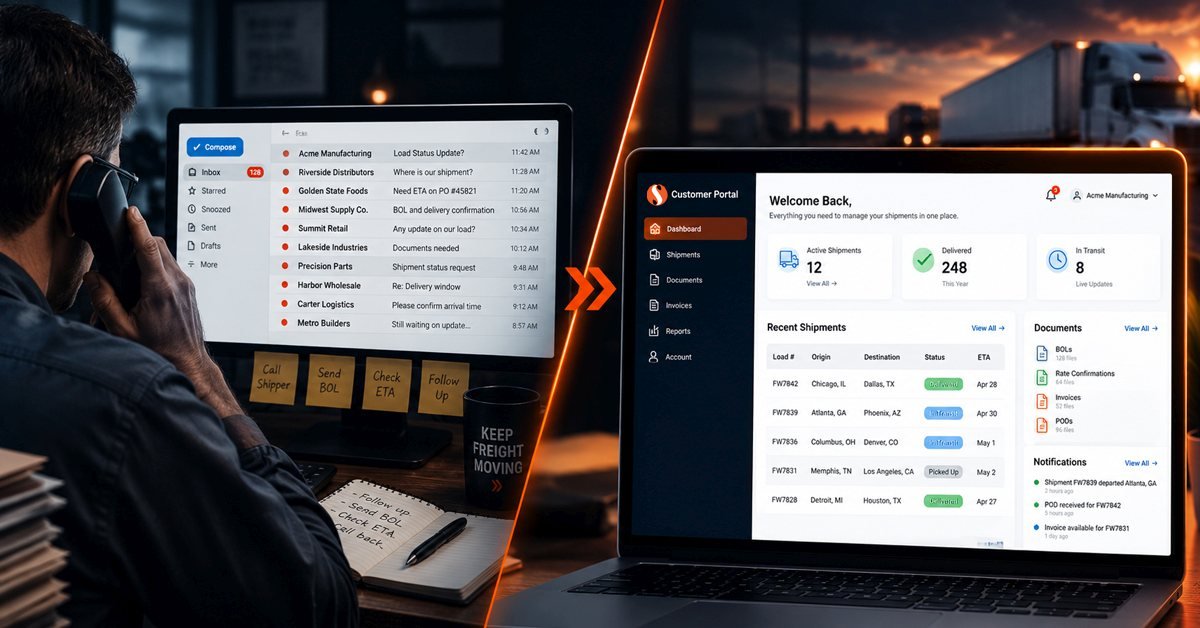
Most transportation company owners do not wake up thinking they need a customer portal. They wake up thinking their dispatchers are spending too much time answering the same questions, their shippers keep asking for documents that are buried somewhere in an email thread, and the phone rings every time someone wants to know where their load is. The portal is not the problem they are trying to solve. Communication overhead and operational friction are the problems. The portal is one solution, and it is not always the right one.
This post is about helping you locate where your operation sits on the digital maturity curve, and whether a customer portal is the right next step or whether something simpler addresses the problem more directly. The answer is not always a portal. Sometimes it is a better freight inquiry form. Sometimes it is a structured document workflow. Sometimes it genuinely is a portal. The goal is to work out which one applies to your business before building anything.
How Transportation Businesses Grow Into Digital Systems
A transportation company's digital presence does not jump from a brochure website to an enterprise platform. It grows in stages, each one triggered by a specific operational problem the previous stage could no longer handle. Understanding which stage you are at is the most important step before deciding what to build next.
The diagram shows something that most conversations about portals skip over entirely: Stage 3. Most transportation companies jump from "we need a better website" directly to "we need a customer portal" without recognising that there is a meaningful intermediate stage. Better freight inquiry workflows, automated document delivery, structured email processes, and shipment notification systems can solve the same operational problems a portal solves, at a fraction of the cost and complexity, and without requiring your shippers to log into anything.
A portal is a communication and visibility layer built on top of an organised operation. It is not the first step in organising one. If the underlying operation is disorganised, a portal simply exposes that disorganisation to customers. The companies that benefit most from portals are the ones who have already worked through Stage 3 and found that self-service access is the only remaining solution to the communication overhead they are still carrying.
What a Transportation Customer Portal Actually Is
A customer portal is a secure digital workspace that gives each shipper access to the information, documents, and actions relevant to their relationship with your company. What that means in practice varies significantly depending on the size of the operation, the type of freight, and how the carrier's existing systems are set up. Sometimes a portal is a section of the carrier's own website with a shipper login. Sometimes it is integrated with a transportation management system. Sometimes it connects to document storage that the carrier's internal team already uses. The technology behind it matters less than the business problem it solves.
What every transportation portal has in common is the same thing: it moves routine shipper interactions off the phone and out of email, into a place where the shipper can help themselves without involving dispatch. The dispatcher who used to spend forty minutes a day fielding "where is my load" calls now spends that time managing loads. The shipper who used to wait for a POD to be emailed gets it from the portal the moment it is uploaded. Neither party benefits from the current arrangement. The portal removes the friction from both ends.
What a Portal Is Not
A customer portal is not a transportation management system. It does not dispatch loads, optimise routes, or manage driver assignments. Those are operational functions that happen inside the carrier's business systems. The portal is the layer that exposes selected information from those systems to shippers in a controlled way.
A portal is also not a substitute for a well-built website. A carrier whose website does not generate freight enquiries or answer shipper questions before they make contact does not need a portal. They need a better website. The portal serves shippers who are already customers. The website serves shippers who are still deciding. Conflating the two is a common and expensive mistake.
The Operational Problems a Portal Solves
Each feature in a transportation customer portal exists because a specific operational problem was costing the carrier time, and phone calls or email threads were the only alternative. The three that come up in almost every conversation are status visibility, document access, and structured load submission.
For a more detailed breakdown of what each portal feature does operationally and how transportation companies structure access across different shipper contacts, our post on how transportation companies use client portals covers the full feature set and the architecture decisions behind it.
The Signs Your Operation Is Ready for a Portal
These are specific, operational signals rather than vague thresholds. If several of them apply to your business simultaneously, the case for a portal is worth taking seriously.
When a Portal Is the Wrong Answer
This section is as important as the previous one. Most agencies write a brief paragraph here and move on. The honest cases where a portal is the wrong answer deserve the same depth as the cases where it is right, because building a portal before the operation is ready for it is an expensive mistake that happens regularly.
Stage 3: The Intermediate Step Most Carriers Skip
The most common mistake we see is the jump from website directly to portal. Stage 3 sits between them and it is where most transportation companies' actual problems can be solved without the complexity and cost of a full portal build.
Stage 3 is highlighted because it is the stage most carriers jump over when they decide they have a communication problem. Automated document delivery using structured workflows can eliminate the POD email problem entirely. Shipment status notifications at key milestones can reduce status call volume by more than half. A structured shipper onboarding email sequence can replace the informal process that currently relies on whoever happens to be available. None of these require a shipper login. All of them address real operational friction.
We have built Stage 3 systems for transportation clients where the initial conversation started with "we need a portal" and the assessment revealed that what they actually needed was a consistent document workflow and a notification system. Six months after launch, the communication overhead was resolved and the shipper feedback was positive. The portal conversation can happen later, from a stronger operational foundation, once the business has grown into the stage where self-service access is genuinely the remaining gap.
What a Transportation Customer Portal Should Include
For operations that have worked through the decision framework and determined that a portal is the right next step, here is what a well-built transportation portal typically includes and why each element earns its place.
Shipper login and user management. Each shipper organisation has one or more user accounts with defined access. A procurement manager sees reporting and rate requests. A logistics coordinator sees shipment status and documents. An accounts payable contact sees invoices. Role-based access means each user sees what is relevant to their function without exposing information that belongs to another shipper or another internal function.
Shipment visibility dashboard. Active loads visible in a status view that reflects the current stage of each shipment. The value is not in real-time GPS tracking, which requires hardware and telematics integration beyond the portal itself. The value is in structured, consistent status updates that dispatchers enter as loads progress, surfaced to shippers without a phone call. When statuses are entered consistently, shippers stop calling to ask.
Document library. Documents attached to each shipment record as they are completed. A shipper can retrieve the POD for any load they have moved with this carrier without contacting anyone. The accounts payable team can pull invoices by date range without asking. When shippers can help themselves, the carrier's team stops being the document retrieval service. This is the feature with the clearest operational return and the lowest complexity to implement well.
Rate request and load submission. For regular shippers, a structured load submission form that collects the information needed to price and schedule a load. Origin, destination, freight type, weight, equipment requirement, pickup window, delivery window, special requirements. When a shipper submits through the portal rather than calling, the carrier's team receives a complete request rather than a partial one. The back-and-forth to gather missing information disappears.
Shipment history and reporting. For shippers who need to report internally on freight spend, volume, or performance, a filtered view of their completed shipments over a selected period. The carrier stops producing manual reports. The shipper's team has self-service access to the data they need. For shippers with regular reporting requirements, this feature alone can justify the portal from their side of the relationship.
Notification preferences. Shippers set which status milestones they want to be notified about and how. Some want an email when the load picks up and when it delivers. Some want updates at every status change. Some want nothing and will check the dashboard when they need to. Notification preferences ensure the portal communicates in the way each shipper finds useful rather than sending uniform updates that some shippers find intrusive.
What This Looks Like for Different Transportation Operations
Portal vs No Portal: By Business Situation
| Business Situation | Website Only or Stage 3 Workflows | Customer Portal |
|---|---|---|
| Fewer than 20 active shippers, relationships personal | Automated document delivery and notifications handle the friction | Over-engineering a relationship that works without it |
| 20 to 50 active shippers, growing direct book | Stage 3 workflows may still be enough depending on call volume | Worth assessing seriously if status calls and document requests are significant |
| 50+ active shippers, several with procurement teams | Stage 3 alone is likely insufficient at this volume | Portal is the practical next step given the self-service requirement |
| Shippers using their own TMS | EDI or API integration into their system is what they need | Portal likely ignored if shippers manage freight in their own platform |
| Regulated freight with compliance documentation requirements | Email document delivery works at low volume but becomes unreliable at scale | Document library with type organisation has direct compliance value |
| Operation data inconsistent, statuses updated irregularly | Fix the operational process first before surfacing it to shippers | Portal will expose the inconsistency rather than solve it |
| No internal champion to manage portal after launch | Workflows require less ongoing management discipline | Portal will degrade without someone responsible for data quality |
| Shippers asking for visibility the current system cannot provide | Check whether Stage 3 notifications answer the same need | If shippers need self-service access, portal is the right answer |
From Website to Digital System
Over the years, we have worked with transportation companies at very different stages of growth. Some needed a well-structured website that generated freight enquiries and supported driver recruitment. Others had reached the point where their website was no longer the challenge. The real challenge was managing customer communication, documents, and operational workflows efficiently as the business grew.
That difference is important because a customer portal is not the next step for every transportation company. We do not recommend portals because they are impressive technology or because they add more features to a website. We recommend them when the business has reached the point where routine communication, document sharing, and customer visibility can no longer be managed efficiently through phone calls, email, and a traditional website alone.
The companies that benefit most from customer portals are not the ones trying to fix operational problems with technology. They are the ones whose operations have grown beyond what a traditional website can reasonably support, who have the internal discipline to keep the portal's data accurate, and whose customers genuinely benefit from self-service access. Working out whether your business has reached that stage is often more valuable than deciding which technology to build.
Frequently Asked Questions
How much does a transportation customer portal cost to build?
The cost varies significantly depending on what the portal needs to do and how it connects to the carrier's existing systems. A portal built on WordPress with a shipper login, document library, and basic shipment status visibility is a different scope from a portal integrated with a TMS, featuring real-time tracking feeds, role-based access across multiple shipper organisations, and automated notification workflows. The most useful framing is not the total cost but the cost relative to the operational time it saves. A portal that removes two hours of daily dispatch time from status calls and document retrieval has a measurable monthly value. When the annual value of that time saving exceeds the build cost within a reasonable period, the investment makes sense. We scope portal projects after the assessment conversation, because the right scope depends on the specific operational problems being solved, and building more than the operation actually needs is its own cost. We recommend starting with a conversation about the specific friction points rather than a specification, because the right solution is often simpler than the initial assumption.
Should a transportation customer portal be built on WordPress or a custom platform?
The technology choice follows the requirements rather than the other way around. A portal with standard requirements, shipper logins, document access, shipment status visibility, rate requests, can be built effectively on WordPress using a combination of user management, form, and workflow tools. This approach integrates naturally with an existing WordPress website and is maintainable without specialist development knowledge for routine updates. When requirements go beyond what WordPress handles well, such as deep integration with external systems, complex role hierarchies across large shipper organisations, or real-time data feeds from telematics or TMS platforms, a custom application built on a framework like Laravel may be the more practical foundation. The decision is not about preference for one technology over another. It is about which approach produces a system that the carrier's team can manage and that does not require specialist intervention for routine changes. We build portals on both platforms depending on what the assessment reveals about the operation's requirements and the team's technical comfort with ongoing management.
How long does it take to build a transportation customer portal?
A well-scoped portal project for a transportation company typically takes between eight and sixteen weeks from confirmed scope to launch, depending on complexity and how quickly the carrier can provide the operational data and content the portal needs. The phases that most affect timeline are the scoping and design phase, where the specific shipper journeys and access requirements are defined, and the data integration phase, where the portal connects to the carrier's existing systems for shipment data and document storage. Carriers who have their shipment data in a consistent, accessible format move faster through integration than those whose data is spread across spreadsheets and email threads. The fastest portal projects are the ones where the carrier has already worked through Stage 3 and has consistent operational data. Our post on what every transportation and logistics website should include covers the website foundation that makes the portal build faster, because a well-structured website and a well-structured portal share the same information architecture.
Not Sure Whether Your Operation Needs a Portal, Better Workflows, or Something Else?
Some transportation companies benefit most from improving their existing website. Others need structured document workflows or shipment notifications. Some have reached the point where a customer portal is the practical next step. The challenge is knowing which stage you are at. We help transportation companies make that decision before recommending a solution.