
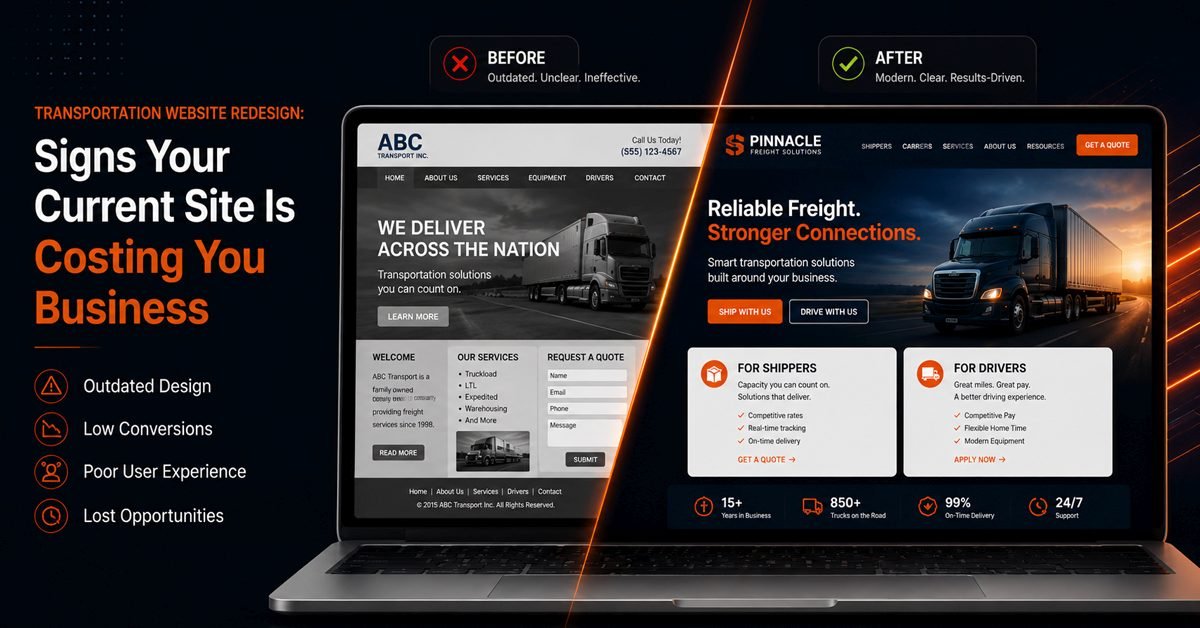
A transportation website rarely fails all at once. It fails gradually, in ways that are easy to explain away individually. The freight inquiry form gets fewer submissions, but the market is slow. The driver applications thin out, but good drivers are hard to find everywhere. The site looks a little dated, but it still loads. None of these feel like a website problem until you look at them together and realise the website was never built to do what the business now needs it to do.
The companies that recognise this early make a considered decision about when and how to rebuild. The ones that do not continue adding content patches and plugin fixes to a site whose architecture was designed for a different version of the business, until the cost of maintaining what they have exceeds the cost of replacing it.
This post covers the specific signs that a transportation website has moved from needing updates to needing a redesign, what those signs mean in operational terms, and how to tell the difference between a problem that a targeted fix can solve and one that the current site structure cannot.
Why Transportation Websites Stop Working Before Anyone Notices
A transportation website built three or four years ago was designed for a business that was smaller, less operationally complex, and competing in a less demanding digital environment. The site may have worked well at the time. The problem is not that it aged. The problem is that the business grew and the website did not grow with it.
A carrier that started with one freight type and two service corridors may now run four freight types across twelve corridors. The original website has a services paragraph. A carrier that initially recruited drivers through word of mouth now needs to generate consistent application volume from an online audience. The original website has a contact form. A carrier whose shippers now expect freight status visibility, document access, and rate request workflows has a website that was built when none of that was operationally relevant.
The gap between what the business does and what the website can represent grows silently. Traffic may hold steady. Impressions may remain reasonable. But the conversion of visitors into freight enquiries, driver applications, and shipper relationships declines because the website is answering questions the business outgrew rather than the questions the business now needs to answer.
Our post on what every transportation and logistics website should include covers the standard that a modern transportation website is measured against. The signs below are the ways a current site typically falls short of that standard in ways that require more than a content update to fix.
Category One: Conversion Failures
Conversion failures are the most visible sign that a transportation website is costing the business freight. They show up as traffic without enquiries, form visits without submissions, and shippers who arrive and leave without making contact. The mechanism is the same in every case: the website is not answering the questions a shipper or driver is carrying when they arrive.
Category Two: Structural Failures
Structural failures are harder to see than conversion failures because they do not produce a clear before-and-after moment. They accumulate as the business adds complexity that the original website architecture was never designed to handle. Each new page becomes a workaround. Each new content requirement becomes a compromise. The site continues to function but cannot represent the business accurately.
Category Three: Trust Failures
Trust failures are the quietest category because they produce no error and no obvious broken element. The site loads, the pages exist, the form works. But the shipper or driver who visits forms an impression that this carrier is generic, unverifiable, or indistinguishable from every other carrier they checked. They move on without making contact because the website gave them no specific reason to stay.
The Cost of Delaying a Redesign
Every year a transportation company postpones rebuilding a website that has reached its structural limits, the cost of that delay compounds in ways that are operational rather than cosmetic. The site becomes harder to update as accumulated workarounds create dependencies that make simple changes unpredictable. Content becomes harder to organise as new pages are added to a structure that was not designed to hold them. Mobile usability falls further behind the standard that shippers and drivers now expect. And every new feature the business needs becomes another workaround layered on top of the previous ones.
This is technical debt expressed in business terms. A carrier that needs to add lane-specific pages to a site that was not built for them can do it, but doing it creates structural inconsistencies that make the next addition harder. A carrier that needs a driver application workflow on a site that has no form infrastructure can build one, but it sits outside the site's natural architecture and breaks in ways that are difficult to diagnose. Over time the cost of maintaining and extending the existing site exceeds the cost of rebuilding it with the right structure from the start.
The business consequence is visible in the numbers. A transportation company whose website cannot represent its full service area cannot rank for the route-specific searches that produce qualified shipper traffic. A company whose driver careers page has not been updated in three years is losing applications to carriers whose pages answer the questions drivers are currently asking. A company whose site loads in six seconds on mobile is invisible to every driver who evaluated it during a break at a truck stop. These are not design problems. They are operational problems that happen to have a website as their source.
What This Looks Like for Different Transportation Operations
Fix vs Redesign: A Clear Decision Framework
| Situation | Targeted Fix | Redesign |
|---|---|---|
| One page underperforming | Rewrite content, add credentials, improve CTA on that page | Not needed unless the page is part of a wider structural problem |
| Generic copy throughout | Rewrite with specific evidence, commodity experience, differentiators | Only if the structure cannot accommodate the content needed |
| No shipper-facing pages at all | Not enough. Content patches on a brochure site do not produce ranking pages | Full shipper architecture needs to be built from the right foundation |
| Driver and shipper content mixed | Not enough. Audience separation requires structural navigation changes | Rebuild with separated audience paths from the navigation level down |
| Mobile experience broken | CSS patches if isolated. Not sufficient if the issue is site-wide | Mobile-first rebuild when the original was not built for mobile |
| Every new feature is a workaround | Not fixable without addressing the underlying architecture | Architecture has reached its limit. Rebuild is the practical investment |
| No service area pages exist | Not fixable by adding content to a site not designed for corridor pages | Lane page architecture needs to be built with the right structure |
| Credentials buried or absent | Add to relevant pages if page templates can accommodate them | Rebuild page templates if they cannot surface credentials without breaking layout |
What a Redesigned Transportation Website Should Be Able to Grow Into
A transportation website redesign is worth doing once and doing with the architecture that supports where the business is going, not just where it is today. The carriers that get the most from a redesign are the ones that build it as a foundation rather than a finish line.
The natural next layer beyond a well-built transportation website is operational systems: a customer portal where shippers can access freight status, documents, and rate history; a driver portal for onboarding documents and compliance records; SharePoint or internal system integrations that connect the website to back-office workflows; role-based dashboards for dispatch teams and management; and SSO that gives clients and staff access to the right information without managing separate credentials. A website redesigned with this trajectory in mind is built on a foundation that can extend into those systems without requiring another full rebuild eighteen months later.
Our post on how transportation companies use client portals covers what that next layer looks like in practice and how it connects to the website that precedes it.
When a Transportation Website Does Not Need a Redesign
A carrier with a relatively recent site that has clear shipper and driver sections, dedicated service area pages, specific equipment capability content, credentials on relevant pages, and a mobile-optimised freight inquiry form does not need a redesign. It may need content improvements, additional lane pages as the business grows into new corridors, or a stronger social proof section. Those are content and maintenance tasks, not architectural ones.
A carrier whose site has low traffic but clear structure also does not need a redesign. Low traffic on a well-structured site is a content depth and backlink problem, not an architecture problem. Adding more lane pages, deeper equipment content, and external links pointing to the site will move rankings in a way that redesigning a well-structured site will not.
The redesign conversation is valid when the structural problems are so embedded that fixing them one at a time costs more in time, effort, and compromised results than rebuilding with the right architecture from the start. That line is different for every carrier, but the signs in this post are where it is usually crossed.
Frequently Asked Questions
How long does a transportation website redesign take?
The timeline for a transportation website redesign depends on the complexity of what is being built. A carrier that needs a new homepage, shipper-facing service area pages, an equipment capability section, a freight inquiry form, and a driver recruitment section is looking at a different timeline than a carrier that additionally needs a client portal, driver application workflows, or integrations with internal systems. The content development phase is often the longest part: gathering real fleet photos, writing specific lane page content, and developing freight capability descriptions that reflect what the carrier actually does takes time to do well. A site that is rushed through content development will underperform regardless of how well it is built technically. The right timeline is the one that produces a site with genuinely useful content on every page, not the fastest one that produces a site that exists. When we work with transportation clients, we spend time understanding the business before we design or build anything, because a website that accurately represents a complex operation cannot be built from a template and a brief conversation.
Should a transportation company redesign its website or improve its existing one?
The decision comes down to whether the problems are in the content or in the structure. Content problems, generic copy, missing credentials on specific pages, a freight inquiry form that needs better fields, a careers page that needs pay information added, are fixable without a redesign. Structural problems, no service area pages, shipper and driver content mixed throughout, mobile experience that cannot be improved without rebuilding, an architecture that cannot accommodate the pages or workflows the business now needs, are not fixable with content updates. The comparison table in this post provides a straightforward framework for identifying which category each problem falls into. If most of the problems are in the content column, start there before committing to a redesign. If most are in the structural column, targeted fixes will produce limited results and the redesign conversation is the practical one to have sooner rather than later. Sentinel Infotech helps transportation companies work through this assessment before recommending anything, because the right answer is not always the bigger project.
What should a transportation website redesign include that the current site does not have?
The answer is specific to each carrier, but the most common gaps between what a current transportation site has and what a redesigned one needs to include are: dedicated service area and lane pages that create search presence across the carrier's full operating territory; separated shipper and driver audience paths so neither has to navigate through content written for the other; equipment capability content built around what shippers need to evaluate rather than internal fleet specifications; credentials displayed on every relevant page rather than buried in a footer; a structured freight inquiry form that collects the information needed to respond with a real rate; a mobile-optimised driver careers section with explicit pay and home time information; and real operational evidence including fleet photos, shipper testimonials, and performance data that differentiates the carrier from generic competitors. Our post on why transportation websites get traffic but no quote requests covers the conversion failures that a redesign needs to address, and our anchor post on what every transportation and logistics website should include covers the full content standard the redesign should be measured against.
Not Sure Whether Your Transportation Website Needs a Redesign or Targeted Fixes?
Not every transportation website needs a redesign. Sometimes targeted improvements are enough. But when structural issues prevent your website from supporting freight enquiries, driver recruitment, or future customer portals, rebuilding becomes the more practical investment. We help transportation companies identify that difference before recommending a redesign.