
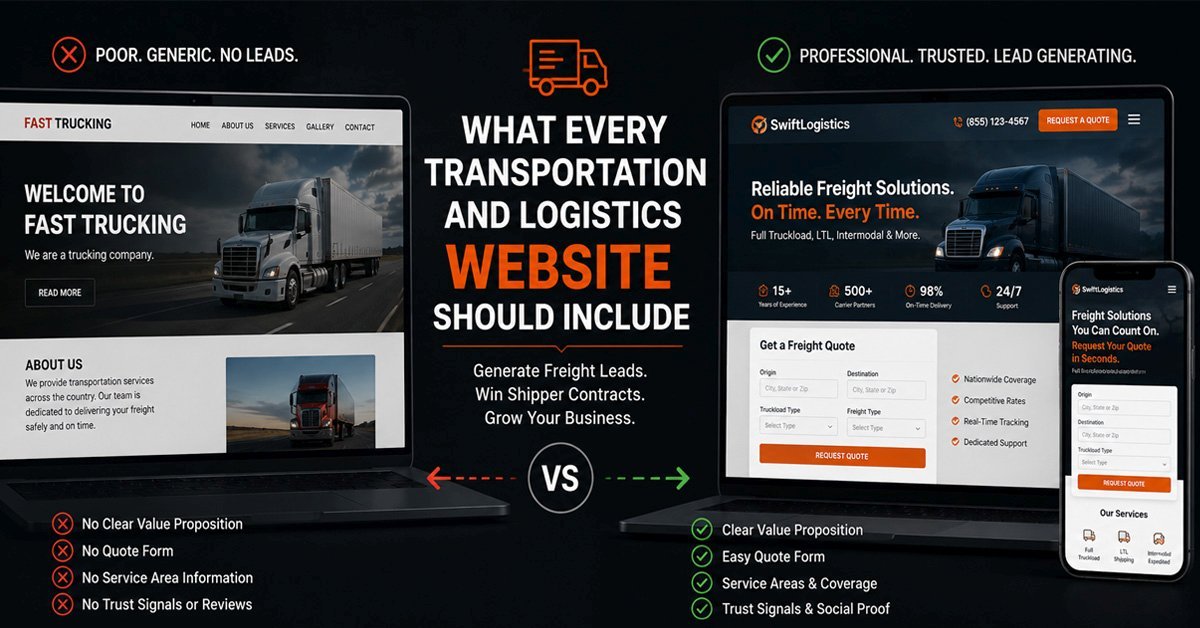
A transportation and logistics website needs to do three things well to win business: establish credibility fast, make it easy for shippers and freight clients to understand what you move and where, and give a prospect a clear path to request a quote without calling the office. Most transportation websites do none of these three things well. They look like they were built to satisfy a checkbox rather than to generate revenue.
At Sentinel Infotech we have built and rebuilt web presences for freight carriers, logistics providers, trucking operations, and 3PL businesses across multiple regions worldwide. The pattern that separates the sites that generate consistent inbound leads from the ones that sit unused is not budget or design style. It is whether the site was built around how a shipper or logistics buyer actually makes a vendor decision, or whether it was built around what the transportation business owner thought a website should look like.
This post covers the specific elements that make a transportation website generate business, organized by what actually influences the decision of a shipper, freight client, or logistics buyer when they are evaluating vendors.
Why Transportation Websites Lose Business Before the Phone Rings
A logistics buyer shortlisting carriers does not spend twenty minutes reading about a company's founding story. They scan three to five websites in ten minutes looking for evidence that a carrier can handle their specific freight type, lane, or service requirement. They are looking for confidence signals: certifications, fleet size, service coverage, safety ratings, and something that tells them this operation is professional enough to trust with their supply chain.
If those signals are not immediately visible, the buyer moves to the next result. Not because the carrier is unqualified, but because their website gave no reason to believe they are. A poorly built transportation website creates doubt, and in logistics where a single failed shipment has real operational consequences for the client, doubt breaks the decision faster than price ever does.
The second way transportation websites lose business before the phone rings is by making the quote request process difficult. A shipper who has to navigate multiple pages to find a contact form, then fill out a generic message field with no structure, then wait for someone to respond with a follow-up call, is a shipper who will choose the competitor whose website gave them a structured freight inquiry form that set clear expectations about response time. Friction in the quote request process directly costs business at the highest-intent moment of the entire sales cycle.
The Essential Elements of a Transportation and Logistics Website
Service Clarity: Why the First Five Seconds Decide Everything
The homepage of a transportation website is not a branding exercise. It is an answer to the question "is this company able to handle what I need?" A shipper who cannot answer that question within a few seconds of arriving on the homepage does not read further. They hit the back button and try the next search result.
Service clarity means the homepage communicates, without any scrolling, what freight types you handle, which regions or lanes you serve, and what makes your operation worth a conversation. This is typically achieved through a headline that states the service and territory specifically, a short subheadline that covers the key differentiator, and either a set of service icons or a brief service list visible in the hero section before any scroll is required.
The most common failure mode is a homepage hero that leads with the company name and a tagline like "Your Trusted Logistics Partner" without specifying what is actually transported or where. That tagline tells a shipper nothing about whether this carrier can handle their freight. It could describe any business in any industry. Specificity is what creates confidence. "Flatbed and heavy haul carriers operating throughout the Midwest and Southeast" tells a shipper immediately whether to keep reading or move on.
The Freight Quote Request Form: Your Highest-Leverage Conversion Tool
A transportation company whose website has only a generic contact form is leaving significant business on the table. A shipper ready to request a rate is at the highest point of intent in the entire sales cycle. How that moment is handled determines whether the lead converts or evaporates.
A generic form asks for a name, email, and message. The shipper writes a paragraph describing their freight. The carrier receives it, reads it, calls to gather the actual details needed to generate a rate, and by the time that call happens the shipper has already received a quote from a competitor whose freight inquiry form captured all of that information upfront.
A proper freight quote request form is built around the specific information the carrier needs to respond with a real rate: origin and destination, freight type and commodity, weight and dimensions, required equipment type, preferred pickup date, and any special requirements such as temperature control or hazmat classification. The form should take a shipper under two minutes to complete on any device, and the submission should trigger an immediate automated acknowledgment that sets a clear expectation for when they will receive a rate.
In many transportation website projects, moving from a generic contact form to a structured freight inquiry form has a significant impact on enquiry quality. It reduces the back-and-forth required to generate a quote, increases the perceived professionalism of the operation, and gives the carrier's team everything needed to respond with a competitive rate quickly, which is the moment most freight business is won or lost.
Dedicated Service Pages: How Transportation Companies Win in Search
A shipper searching for a specific service does not search "transportation company." They search "flatbed trucking [region]" or "refrigerated freight carrier [state]" or "LTL freight quote [city]." A transportation website with a single services page listing everything in a few paragraphs cannot rank for any of those specific queries. A website with dedicated pages for each service type can compete for all of them.
Each service page should describe the specific service in enough depth to give a shipper confidence that the carrier understands the requirements of that freight type. A flatbed page should address the specific commodities typically moved on flatbed, the tie-down and securement approach, permits for oversized loads, and the equipment available. A reefer page should address temperature range capability, food-grade cleaning standards, and the monitoring approach for temperature-sensitive shipments. This depth of information serves two purposes simultaneously: it gives shippers the confidence to inquire, and it gives search engines the content needed to rank the page for the specific queries that shipper used.
Equipment Pages Build Credibility and Search Presence
Beyond service type pages, equipment-specific pages serve a distinct purpose for transportation businesses with varied fleets. A shipper with a specific load requirement wants to know whether the carrier has the right equipment before they spend time getting a quote. An equipment page that details the fleet, dimensions, weight capacity, and current availability by equipment type answers that question without a phone call and signals operational sophistication to shippers who know what they need.
Equipment pages also serve a secondary purpose for driver recruitment. A driver evaluating a carrier wants to know what equipment they would be operating. A detailed, well-maintained equipment page serves both the commercial and the operational audience simultaneously.
Coverage and Lane Pages: How to Win Business Beyond Your Main Address
A carrier operating between Chicago and Atlanta is invisible in search for "Chicago to Atlanta freight carrier" if they have no page addressing that lane specifically. The same carrier could be the most reliable option on that route and still lose the search-driven business to a competitor who built a lane page for it.
Lane pages work the same way as service area pages for home service businesses. Each page addresses a specific origin-destination pair or region, covers the service frequency or transit times for that lane, mentions any relevant equipment available for that corridor, and provides a clear path to request a rate for that specific movement. Done correctly, lane pages create search presence across the carrier's full operating territory rather than concentrating all visibility on the primary address city.
The quality standard that separates a lane page that ranks from one that does not is the same across every industry: the page needs to contain genuinely useful information that serves the searcher, not just a city name swapped into a template. A shipper searching for freight capacity on a specific lane finds a useful page that earns a click and a quote request, or they find a thin page that looks like it exists only to game search rankings and they click back immediately. Only the first type ranks over time.
Compliance and Safety Credentials: The Trust Layer Shippers Actually Look For
In transportation, credentials are not supplementary information. They are qualifying criteria. A shipper's logistics or procurement team evaluating a new carrier is checking DOT authority, safety ratings, insurance levels, and any relevant certifications before they approve the carrier for their freight. If those credentials are not visible on the website, the shipper either has to ask for them, which adds friction and time, or they move to a carrier whose website already provided the information they needed.
DOT number and MC authority should be visible on the homepage and contact page at minimum. The FMCSA safety rating should be mentioned if it is satisfactory. Insurance levels relevant to the freight types handled should be stated clearly on service pages. Any industry certifications, such as Certified Cargo Security Professional credentials, TSA-approved carrier status, or pharmaceutical or food-grade compliance certifications, should be prominently featured on the relevant service pages.
The placement matters as much as the presence. Credentials buried in a footer or on a dedicated "compliance" page that requires navigation to find are not serving the shipper who is scanning the homepage for reasons to shortlist this carrier. Credentials on the homepage and service pages are visible at the moment of evaluation, which is when they actually influence the decision.
Client Portals and Tracking: The Operational Credibility Signal
A transportation company that offers clients self-service access to their shipment tracking, documents, invoices, and account history signals a level of operational sophistication that differentiates it from carriers who manage all of that communication manually. The presence of a client portal or a tracking link in the main navigation of a transportation website communicates, without any explanation, that this operation has invested in systems and takes client communication seriously.
For logistics providers, 3PLs, and carriers with recurring client relationships, the client portal is not just an operational tool. It is a visible signal of professionalism that influences whether a new prospect believes this carrier can handle their account at scale. Our post on how transportation companies use client portals covers the architecture of these systems and what separates a portal that reduces overhead from one that adds complexity without value.
Driver Recruitment: The Second Audience Most Transportation Websites Ignore
A transportation website serves two distinct audiences: the commercial side (shippers, freight clients, logistics buyers) and the operational side (drivers and owner-operators evaluating whether to work with this carrier). Most transportation websites are built entirely for the commercial audience and ignore the operational one, even though driver recruitment is one of the highest-cost operational challenges in the transportation industry.
A dedicated driver recruitment section with current openings, pay structure transparency, home time policies, equipment information, and a simple online application form turns the website into an active recruiting tool that works around the clock without a staffing agency fee. The application form should be as easy to complete on a phone as it is on a desktop, since most driver applications happen from mobile devices.
Driver-focused content also serves the commercial audience indirectly. A transportation company that visibly invests in driver quality, retention, and working conditions is a more credible logistics partner than one that says nothing about how it manages its workforce. Safety ratings, driver training programmes, and retention statistics are legitimate credibility signals for shippers evaluating whether a carrier's operations are stable enough to rely on.
What a Transportation Website Looks Like When It Works
Use Cases: What This Looks Like Across Different Transportation Operations
The Comparison: Transportation Websites That Generate Business vs Ones That Do Not
| Element | Website That Wins Business | Website That Does Not |
|---|---|---|
| Homepage first impression | Service type and coverage territory clear within 5 seconds, no scrolling required | Company name, generic tagline, stock photo of a truck. Service and coverage unknown without reading |
| Quote request | Structured freight inquiry form capturing freight type, lane, weight, timeline, and contact details | Generic contact form with a message field where the shipper writes a paragraph |
| Service coverage | Dedicated pages per service type and key lanes, each with specific and useful content | One services page listing all services in a few sentences |
| Compliance credentials | DOT number, MC authority, safety rating, and insurance levels visible on homepage and service pages | No credentials visible without emailing to ask, or buried in an about page footer |
| Client communication | Client portal or tracking access visible in navigation for existing client self-service | All client communication handled by email and phone, no self-service option |
| Driver recruitment | Dedicated recruitment section with current openings, pay details, and online application | No driver information, or a single paragraph mentioning they are "always looking for drivers" |
| Mobile experience | Fast, functional on any device, quote form works correctly on phone | Desktop-first design, slow on mobile, form difficult to complete on a phone screen |
| Search visibility | Service pages and lane pages indexed and ranking for specific freight type and territory queries | Homepage only, invisible in search for specific services or operating lanes |
What Transportation Websites Should Not Waste Budget On
Understanding what generates business from a transportation website also clarifies what does not. Several investments that transportation businesses commonly make have little measurable impact on lead volume or client acquisition.
Animated header videos of trucks on highways. These look impressive in a presentation and slow down mobile page load times by seconds. A shipper who cannot see the service information quickly because a video is loading is not impressed. They have already moved on.
Generic content about the transportation industry. Blog posts about industry trends, fuel prices, or driver shortage statistics do not generate freight leads. They generate traffic from people in the industry reading about the industry, not from shippers looking for a carrier. Content investment should go to service pages, lane pages, and freight type pages that serve the actual search queries of logistics buyers.
Social media feeds embedded on the homepage. A shipper evaluating a carrier does not need to see the company's last ten social media posts on the homepage. This is space that could carry a service overview, a quote request form, or compliance credentials. Social activity belongs in the footer where it is accessible without competing for the attention of a high-intent visitor.
Awards and recognitions sections without context. A "Best Trucking Company 2023" badge from an unknown publication tells a shipper nothing about whether this carrier can handle their specific freight. Client references, safety statistics, and on-time delivery rates are evidence. Awards without context are decoration.
Frequently Asked Questions
Does a transportation company need a website or is a Google Business Profile enough?
A Google Business Profile handles local visibility for nearby searches and drives calls from the map pack, but it cannot do what a website does for a transportation business. It cannot carry the service and equipment detail a shipper needs to qualify a carrier. It cannot host a structured freight inquiry form. It cannot rank for specific freight type and lane searches. It cannot provide a client portal for existing account management. And it does not allow the depth of compliance credential presentation that logistics buyers need to see before they approve a new carrier. For a transportation company competing for freight contracts beyond simple local searches, a website is not optional. A Google Business Profile and a website together are the correct combination, not one or the other.
How many lane or coverage pages does a transportation website need?
The right number is the number of lanes or regions where the business actually operates and wants to win business, not an arbitrary target. A carrier with three primary corridors needs three well-built lane pages. A regional carrier operating across fifteen states may benefit from state-level coverage pages for each territory. The quality standard matters more than the quantity: each page needs to contain genuinely useful information about service frequency, transit times, available equipment, and how to request capacity on that lane. A thin page that exists only to create search presence for a location will not rank and will not convert visitors who do find it. Build pages that serve the shipper searching for capacity on that specific lane, and the search rankings follow naturally.
Should a transportation company website be built on WordPress or a custom platform?
WordPress is well suited for the marketing and lead generation layer of a transportation website: service pages, lane pages, freight inquiry forms, driver recruitment, blog content, and compliance credential presentation all work cleanly in WordPress with the right build approach. Where WordPress reaches its limits for transportation businesses is in the operational layer: complex client portals with role-based access, API integrations with dispatch or TMS software, and custom reporting dashboards that pull from operational systems. Those components typically warrant a custom application built alongside the WordPress marketing site rather than inside it. The right architecture depends on what the operational requirements actually are. A transportation business that needs a public-facing marketing site with a structured quote form and a driver recruitment section can build that entirely in WordPress. One that needs a client portal handling hundreds of accounts with real-time data from a TMS integration needs a custom application layer regardless of what powers the public site. Our transportation and logistics web development service covers how we approach that decision for different operation types.