
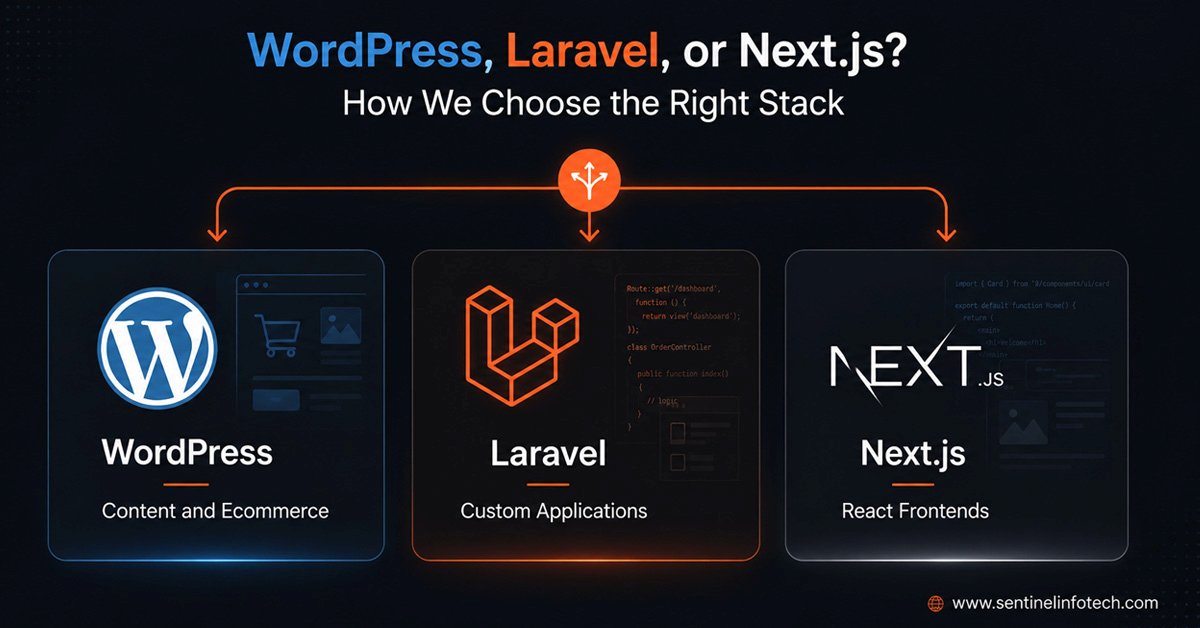
Every few months, a client comes to us having already decided on a technology before they have fully thought through what they are building. Sometimes a founder read that Next.js is the modern choice and insists on it for a simple marketing site. Sometimes a business owner wants everything in WordPress because their last agency used it. Sometimes someone wants Laravel because they heard it is the professional choice.
All three are genuinely good technologies. All three are the wrong choice in the wrong context. The decision that matters is not which technology is best overall. It is which technology is the right fit for this specific project, this team, and this business goal. After building with all three for 15 years across hundreds of projects for businesses worldwide, the decision framework we use is less about the technology and more about the project itself.
This post explains how we actually make that call, including the cases where we push back on what a client initially requests.
Why This Decision Matters More Than Most Clients Realise
The technology choice at the start of a project sets the trajectory for everything that follows. The wrong choice does not usually cause immediate failure. It causes friction that accumulates over time. A WordPress site built for a use case that genuinely needed custom application logic becomes harder to maintain as requirements grow. A Laravel application built for a simple content site costs far more to maintain than it should. A Next.js frontend built for a team that has no frontend expertise becomes a bottleneck every time something needs to change.
We have inherited projects built in all three technologies where the original choice was a poor fit. The pattern is consistent: the first year works reasonably well, and then the cracks appear as the product grows or the team changes. Rebuilding later is always more expensive than choosing correctly at the start.
When We Choose WordPress
WordPress is the right choice far more often than its critics acknowledge and far less often than its loudest advocates suggest. The key is understanding what WordPress is genuinely good at versus where it starts to struggle.
WordPress is a content management system that has evolved into a capable application platform. That evolution comes with real strengths and real limits. We choose WordPress when the project fits these conditions.
When WordPress is not the right choice
WordPress struggles when the application logic becomes the primary product rather than the content. Multi-sided marketplaces with complex transaction flows, real-time applications, systems with intricate user role logic across many tenants, and anything requiring deep custom API architecture are all places where WordPress starts bending in ways that create long-term pain.
The tell is usually in the plugin count. When a WordPress project requires 30 or more plugins to function, many of them doing things the CMS was not designed for, the technical debt accumulates faster than the features deliver value. We have seen sites that work fine at launch become genuinely difficult to maintain within two years because the WordPress foundation was carrying weight it was not built for.
For stores specifically, the point at which WordPress and WooCommerce starts to strain under growth is covered honestly in the post on what happens when WooCommerce stores reach scale.
When We Choose Laravel
Laravel is a PHP framework, not a CMS. That distinction matters. You do not install Laravel and get a working website. You build a website with Laravel. That means more upfront development time and a higher ongoing maintenance requirement. It also means complete control over the application architecture, the data model, and the business logic.
We choose Laravel when the business logic is the product. When the rules around how data moves through the system, how users interact with each other, how permissions work, and how integrations connect are complex enough that a pre-built CMS would spend most of its time fighting against those requirements rather than supporting them.
When Laravel is not the right choice
Laravel is not the right choice when the team maintaining it cannot work with it. A Laravel application handed to a team that only knows WordPress becomes a liability. The ongoing maintenance, the security updates, the deployment process, and the debugging all require developer involvement that a CMS would not.
It is also not the right choice when the requirements are straightforward and the timeline is tight. Building a standard business website in Laravel when WordPress would serve the purpose costs more money and takes longer for no meaningful benefit. We push back on Laravel requests that are really about technical preference rather than genuine business requirements.
When We Choose Next.js
Next.js is a React framework that handles server-side rendering, static generation, and the tooling around a modern JavaScript frontend. It is not a replacement for WordPress or Laravel. It is a frontend layer that often sits in front of one of them.
The confusion we see most often is clients asking for Next.js when they mean they want a modern, fast website. Next.js does produce fast websites. So does a well-built WordPress site. The question is not whether Next.js is fast. It is whether the specific project benefits from what Next.js uniquely provides.
When Next.js is not the right choice
Next.js is not the right choice for most standard business websites. The additional complexity of a JavaScript frontend, the build pipeline, the deployment infrastructure, and the separation between content management and frontend rendering all add friction that most businesses do not need.
We have written honestly about this before. Our post on whether headless WordPress with React and Next.js is worth it covers the genuine trade-offs, and our post on why headless WordPress projects fail covers what goes wrong when the architecture does not fit the team or the requirements. The short version: headless is powerful when the use case genuinely needs it and problematic when it is chosen for its own sake.
How the Three Technologies Compare
| Consideration | WordPress | Laravel | Next.js |
|---|---|---|---|
| Primary strength | Content management and ecommerce | Custom application and API logic | Interactive React frontend |
| Time to first launch | Fastest | Slowest | Medium |
| Non-technical content editing | Excellent | Requires custom build | Needs a CMS behind it |
| Custom business logic | Limited beyond plugins | Full control | Frontend only |
| Plugin and extension ecosystem | Largest ecosystem | Good package ecosystem | Component libraries |
| Ongoing maintenance cost | Lowest | Highest | Medium |
| Performance ceiling | Good with proper setup | Very high | Very high |
| Team skill requirement | Lower barrier | Senior PHP/Laravel dev needed | React expertise required |
| SEO out of the box | Strong with Rank Math or Yoast | Requires custom implementation | Strong with SSR/SSG |
| Ecommerce capability | Excellent with WooCommerce | Custom build required | Needs backend integration |
The Decision Framework We Actually Use
When a new project comes in, the first conversation is never about technology. It is about the business, the users, and the team. The technology decision follows from those answers rather than leading them. Here is the framework we work through.
The Three Questions We Ask in Order
Real Projects, Real Decisions
Abstract frameworks only go so far. Here is how this plays out in practice across projects we have worked on with businesses in India and worldwide.
The Combination Approach
Not every project is a clean fit for a single technology. Some of the most effective architectures we have built combine two of these technologies deliberately.
WordPress plus Laravel API: WordPress manages the content and the frontend. A Laravel API handles the complex business logic that WordPress cannot manage cleanly, such as a booking system with availability logic, a quote calculator with custom rules, or an integration with a legacy business system. The two systems communicate via API. Neither is stretched beyond what it does well.
Laravel backend plus Next.js frontend: Laravel handles all the server-side application logic, the database, the authentication, and the business rules. Next.js handles the frontend, consuming the Laravel API. This is the right architecture for complex applications that need both powerful backend logic and highly interactive frontends. It is also the highest-cost architecture and only appropriate when both elements are genuinely needed. Our React and Next.js development service typically works in this model when the project warrants it.
Headless WordPress plus Next.js: WordPress stays as the CMS because content editors know it. Next.js delivers the frontend because the performance or design requirements go beyond what a traditional WordPress theme can provide. As we covered in our post on headless WordPress with React and Next.js, this works well when the use case is genuine and fails when it is chosen for the wrong reasons.
When We Push Back on the Client's Initial Choice
Clients sometimes arrive with a technology decision already made. We do not simply build whatever is requested. Part of the value of working with an experienced agency is honest advice about whether the initial choice actually fits the problem.
We push back when we see these patterns. A client requesting Laravel for a straightforward marketing site where WordPress would serve perfectly and cost half as much. A client requesting WordPress for a multi-tenant SaaS product where the plugin approach will create unmanageable technical debt. A client requesting Next.js for a simple blog where static WordPress would outperform it in both speed and maintainability.
That pushback is not about having a preferred technology. We have built extensively with all three and continue to do so. It is about the client getting a result that serves their business for years rather than one that looks good on a proposal and creates problems later.
When Not to Use Any of These
There are cases where none of these three technologies is the right choice for a specific requirement. A simple landing page with no CMS requirement might be better served by a static HTML site. A simple internal tool might be better served by a no-code platform. A product that does not yet know what it is might be better served by a prototype in whatever the founding team knows best before any architectural decisions are made.
We will say this directly: technology decisions made before the business requirements are clear are frequently wrong. The right time to choose between WordPress, Laravel, and Next.js is after you understand what you are building, who will use it, who will maintain it, and what success looks like in two years. Not before.
A Practical Conclusion
If you are deciding between WordPress, Laravel, and Next.js for your next project, the clearest advice we can give is to start with the business requirements, not the technology. Write down what the product needs to do, who will use it, and who will maintain it after launch. Then look at which technology fits those answers rather than which one sounds most impressive or modern.
WordPress is underestimated by developers and overextended by agencies who should know better. Laravel is the right tool for genuine application complexity and the wrong tool when simplicity would serve. Next.js is powerful for the right frontend requirements and unnecessary overhead for most standard web projects.
If you are not sure which fits your project, that conversation is exactly what our initial consultation is for. We work with businesses across multiple industries worldwide and have made this decision enough times to give you an honest answer rather than a convenient one. Our WordPress development service, Laravel development service, and React and Next.js development service pages cover what each looks like in practice.
Frequently Asked Questions
Can I switch from WordPress to Laravel or Next.js later if I outgrow WordPress?
Yes, but it is not a migration. It is a rebuild. The data can usually be exported and imported but the application itself needs to be rebuilt from scratch in the new technology. This is why the initial technology choice matters. A rebuild is expensive and disruptive. Starting with the right technology avoids it. That said, we have managed several such transitions for clients who genuinely outgrew their initial platform, and a well-planned rebuild at the right time is a reasonable decision when the business has grown to justify it.
Is Next.js better for SEO than WordPress?
Not inherently. Both can produce excellent SEO results when built correctly. WordPress with Rank Math or Yoast has a mature and well-understood SEO toolset. Next.js with server-side rendering or static generation produces fully crawlable pages that Google handles well. The SEO outcome depends on implementation quality more than the technology choice. A poorly built Next.js site will not outrank a well-built WordPress site, and vice versa. If SEO is the primary reason someone is considering Next.js over WordPress, it is usually not a sufficient reason on its own.
How long does a Laravel project take compared to a WordPress project?
Laravel projects typically take two to three times longer than comparable WordPress projects, sometimes more. This is not a flaw in Laravel. It reflects that Laravel requires building what WordPress ships with by default: user authentication, content management, admin interfaces, and plugin integrations all need to be built rather than configured. For projects that genuinely need Laravel, that build time is justified by the control and scalability it provides. For projects that do not, it is unnecessary cost. Timeline is one of the clearest signals that a project should be evaluated carefully before choosing Laravel over WordPress.
WordPress vs Laravel for startups: which is the better choice?
For most startups, WordPress is the faster and more cost-effective starting point. The exception is when the product itself is the application logic rather than the content. A startup building a SaaS tool, a marketplace, or a data-driven platform needs Laravel or a similar framework from the start because the business logic cannot be built cleanly on a CMS. A startup building a content site, a service business website, or a straightforward ecommerce store will move faster and spend less with WordPress. The common mistake is choosing Laravel because it sounds more serious or scalable, when the actual requirements would be served well by WordPress for years.
Can WordPress scale as much as Laravel?
For content and ecommerce, WordPress scales further than most people expect. Sites handling millions of monthly visitors and stores processing thousands of orders per day run on WordPress with the right infrastructure. The scaling ceiling is not really about WordPress versus Laravel. It is about what the application is doing. WordPress scales well when it is doing what it was designed for. It struggles when it is carrying complex application logic that belongs in a proper framework. Laravel scales extremely well for application logic but is not inherently better at serving content at scale than a well-optimised WordPress installation on appropriate infrastructure.
Is Next.js overkill for small business websites?
Yes, in most cases. A small business website needs to load fast, be easy to update, and rank well in search. WordPress handles all three without the complexity of a JavaScript frontend framework. Next.js adds a build pipeline, a deployment infrastructure, a separation between content editing and frontend rendering, and an ongoing maintenance requirement that most small businesses cannot manage without developer involvement for every content change. The performance advantage of Next.js over a well-built WordPress site is real but rarely significant enough to justify the added complexity for a small business. Next.js earns its place when the frontend requirements genuinely need it, not because it is the modern choice.