
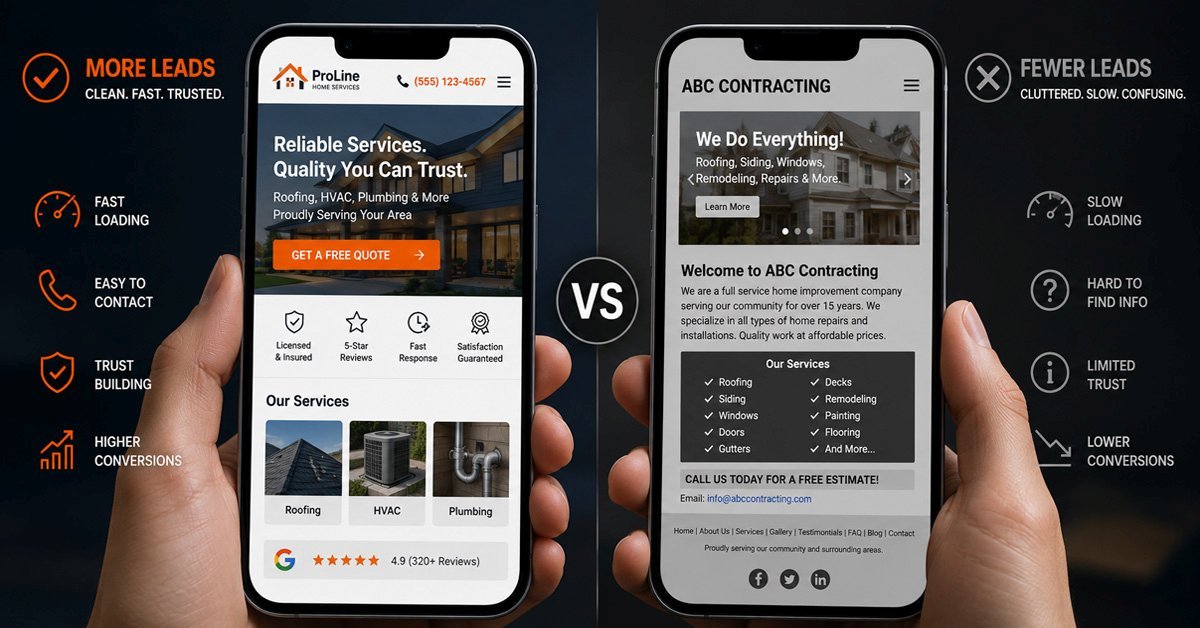
We have built and audited home service websites for roofing companies, HVAC contractors, plumbers, electricians, and landscaping businesses for over 15 years. The pattern that separates high-performing sites from low-performing ones is consistent enough that we can identify it within minutes of reviewing a contractor's website.
The sites that generate more leads are not always the ones with better design. They are not always the ones with more content or better photography. They are the ones built around a specific understanding of how a homeowner makes a hiring decision, and what that homeowner needs to see, find, and feel before they submit a quote request or pick up the phone.
This post covers the specific differences between contractor websites that generate consistent leads and the ones that receive traffic without converting it. Every point here is drawn from real projects, not from general web design principles.
The Trust Decision Happens Before the Phone Call
When a homeowner searches for a roofing company, an HVAC technician, or a plumber, they typically visit two to four websites before deciding who to contact. That initial evaluation takes less than two minutes per site. The decision about which contractor to call is usually made before any conversation happens.
What the homeowner is doing in those two minutes is not comparing service descriptions. They are looking for evidence that this contractor is trustworthy, competent, and accessible. They want to know that other homeowners have used them and been satisfied. They want to see proof of the actual work. They want to know how to reach them immediately if needed. And they want to be able to request a quote without calling if it is outside business hours.
A website that answers all of those questions clearly and quickly wins the contact. A website that makes any of those questions harder to answer loses to the competitor whose site answers them faster.
What High-Lead-Volume Home Service Websites Do Differently
1. The Conversion Path Is Visible Immediately on Mobile
Most local home service searches happen on a phone, often at the moment the problem appears. A homeowner who notices a roof leak on a Saturday morning is searching on their phone. An HVAC system that stops working in the middle of summer triggers an immediate phone search. At that moment, the homeowner needs to find a contractor's phone number or quote form in under three seconds without scrolling.
High-performing home service websites have a sticky header on mobile that keeps the phone number and a contact button visible at all times regardless of where the visitor is on the page. Low-performing sites bury the contact information in a footer or on a separate page that requires navigation to find.
The test is simple. Pull up your current website on your phone and count how many taps it takes to initiate contact from any page. If the answer is more than one tap, you are adding friction at the moment of highest intent.
2. Service Area Pages Make the Business Visible Beyond Its Main Address
A homeowner searching for a roofer does not search "roofing company." They search "roofing company [their city]." A contractor serving ten cities but with only one homepage is invisible in nine of them. The homeowner in a city the contractor serves but has no dedicated page for will find a competitor who does.
Service area pages are one of the highest-leverage additions a contractor website can make because they directly expand the geographic footprint of the business in search without requiring any additional advertising spend. Each properly built service area page creates a presence in that city for every relevant search query.
The distinction between a service area page that ranks and one that does not comes down to content quality. A page that simply swaps a city name into a template is not a service area page. It is a duplicate content risk. A page with genuinely useful local content, the specific services offered in that area, local considerations relevant to the trade, and a clear path to request a quote for that location is a page that earns rankings because it serves the searcher.
3. The Quote Request Form Qualifies Leads Before the First Call
High-lead-volume contractor websites do not just have a contact form. They have a quote request form built around the specific information a contractor needs to prioritize and prepare for a lead before calling back.
A roofing company's quote form asks about roof type, approximate size, and the nature of the issue. An HVAC contractor's form asks whether it is a new installation or a service call, the age of the existing system, and the nature of the problem. A plumber's form asks whether it is an emergency or a scheduled job and what type of service is needed.
This pre-qualification serves two purposes. It reduces the time spent on leads that are outside the service area or scope. And it means the contractor walks into the first conversation already knowing what the job involves, which makes the callback more professional and more likely to convert. Our full contractor website checklist covers this and every other essential element in detail.
4. Reviews Are Visible on the Site Itself, Not Just on External Platforms
A homeowner evaluating contractors will look for social proof before making contact. If that social proof exists only on Google or Yelp, it reaches only the homeowners who actively navigate to those platforms to check. Reviews displayed directly on the contractor's own website reach every visitor at the moment they are deciding whether to reach out.
The difference in conversion between a contractor website that shows live Google reviews prominently on the homepage and service pages versus one that has no visible reviews is measurable and consistent. The live feed matters more than static testimonials because it is current, verifiable, and growing automatically as new reviews come in. A homeowner who sees that the last review was posted two weeks ago gets more reassurance than one who sees testimonials that could have been written at any point.
5. Past Work Is Shown, Not Just Described
In home services, showing the work is more persuasive than any written description of it. A roofing company that shows before and after photos of fifty completed jobs gives a homeowner concrete evidence to evaluate. One that describes its work in general terms without showing it asks the homeowner to trust a claim without proof.
The organization of the gallery matters as much as its existence. A homeowner looking for examples of metal roof replacements in their neighborhood should be able to find them quickly rather than scrolling through fifty unfiltered photos. Galleries organized by service type, material, or project scope serve visitors better and keep them on the page longer, which increases the likelihood of a quote request before they leave.
6. Trust Credentials Are on Service Pages, Not Hidden in a Footer
Licenses, insurance certificates, manufacturer certifications, and satisfaction guarantees are the evidence a homeowner uses to justify a trust decision. When this information is only in a footer or an about page, it reaches only the small fraction of visitors who navigate specifically to find it.
High-converting home service websites place relevant credentials directly on service pages where the homeowner is already reading about the specific service they need. A homeowner reading about roof replacement should see the roofing license and insurance information on that same page, at the moment the trust question is most active in their mind.
The Local SEO Layer That Most Contractor Sites Are Missing
Beyond the conversion elements visible to the homeowner, high-lead-volume home service websites have a technical layer that determines how visible they are in local search before a visitor even arrives. This is the local SEO infrastructure that most contractor sites are built without.
The most impactful technical elements are LocalBusiness schema markup that tells search engines exactly what the business does and where it operates, correctly structured service area pages with unique content and local relevance signals, and internal linking that connects service pages to service area pages in a way that distributes search authority across the whole site rather than concentrating it on the homepage.
A roofing company whose homepage ranks for "roofing company [main city]" but whose service area pages are thin or absent is leaving all the surrounding territory searches to competitors who have invested in that coverage. For trades like roofing, HVAC, and plumbing where most searches are location-specific, the service area page architecture is often the most significant SEO opportunity available.
The Mobile Experience Is the Only Experience That Matters for Local Searches
Local home service searches are predominantly mobile searches. A homeowner who notices a plumbing problem searches on their phone. Someone whose HVAC system breaks in summer heat is not walking to a desktop to find a contractor. The website experience on a phone is the primary experience for most of the highest-intent visitors a home service business receives.
A site that loads in 5 seconds on mobile loses visitors who will not wait. A form that is difficult to complete on a phone keyboard loses leads who would have converted on a desktop. A phone number that is not tappable on mobile adds friction to the simplest possible conversion action.
Auditing a contractor website's mobile experience separately from the desktop experience consistently reveals gaps that are not obvious from the desktop. The sticky header that works perfectly on desktop may overlap content on smaller phones. The quote form that is clean on a wide screen may require horizontal scrolling on a phone. The before and after gallery that loads quickly on a fast connection may time out on a typical mobile data connection.
How the Gap Between High and Low Lead Volume Compounds Over Time
The lead volume difference between a well-built and a poorly built contractor website does not stay constant. It compounds. A site that generates more leads builds more reviews. More reviews improve local search rankings. Better rankings bring more visitors. More visitors generate more leads. The cycle compounds in favour of the contractor who invested in the right website infrastructure early.
A contractor whose site generates one lead per week while a competitor's site generates eight is not just seven leads behind this week. They are seven reviews behind over time, a ranking gap behind because of lower engagement signals, and seven opportunities behind to build the referral network that comes from satisfied clients who found them online. The compounding effect of a high-performing website versus a low-performing one grows larger over 12 to 24 months, not smaller.
What Home Service Websites Should Not Waste Budget On
Understanding what drives leads also clarifies what does not. Several website investments that contractors commonly make have little impact on lead volume and divert budget from the elements that actually matter.
Animated homepage designs that take 8 seconds to fully load add visual interest for the 30 seconds a homeowner might spend on the homepage. They cost lead volume from every visitor who leaves during the load wait on mobile.
Blog content unrelated to the services offered adds page count without serving the visitor who arrived looking for a contractor. Generic home improvement articles that could appear on any site do not differentiate the contractor or convert the visitor.
Social media buttons in prominent positions invite visitors to leave the site before they have converted. Social links belong in the footer where they are available without competing with the quote request button for attention.
Stock photography of random homeowners or generic workers does not build trust the way photos of actual completed projects do. A gallery of real jobs is more persuasive than any amount of stock photography regardless of how professional the stock images appear.
The pattern across all of these is that they serve the appearance of a good website rather than the function of one. A contractor website's function is to convert visitors into leads. Everything that serves that function is worth investing in. Everything that serves appearance at the expense of function is worth cutting.
Our home services website development page covers the full architecture of how we build contractor websites around lead generation from the ground up. And if you want to evaluate your current site before deciding whether to rebuild, the contractor website checklist gives you a structured way to identify exactly which elements are present and which are costing you leads.
Frequently Asked Questions
How many leads should a home service website generate per month?
The number depends on the trade, the service territory size, and the traffic the site receives. A more useful benchmark than a raw lead count is the conversion rate from visitor to lead. A well-optimized home service website typically converts 3 to 8 percent of visitors into leads depending on the trade and the quality of the traffic. A conversion rate below 2 percent on a site receiving meaningful traffic indicates a website problem rather than a traffic problem. If the conversion rate is acceptable but lead volume is low, the issue is traffic volume, which is typically addressed through local SEO, service area page coverage, and Google Business Profile optimization rather than website changes.
Should a home service website have a live chat feature?
Live chat can improve lead volume for businesses with the staff capacity to respond during business hours. An unmanned chat widget that shows as offline or takes hours to respond creates a worse impression than no chat at all. For most smaller home service businesses, a well-designed quote request form with a fast email notification to the contractor's phone is more reliable than live chat and does not require anyone to monitor a chat window. AI-powered chat that can handle initial enquiries and collect job details is worth considering for businesses with higher lead volume, but should be evaluated against whether the cost and complexity is justified by the lead volume the business is already handling.
How important is Google Business Profile compared to the website for generating leads?
Google Business Profile and the website work together rather than in competition. The Google Business Profile drives map pack visibility and direct calls from Google Search results. The website converts visitors who click through from search results, maps, or other sources. A business with a strong Google Business Profile and a weak website generates calls directly from Google but loses the visitors who click to the website before deciding whether to call. A business with a strong website and a weak Google Business Profile misses the map pack traffic that often represents the majority of local search clicks. Both need attention for a home service business to capture its full potential lead volume from local search.