
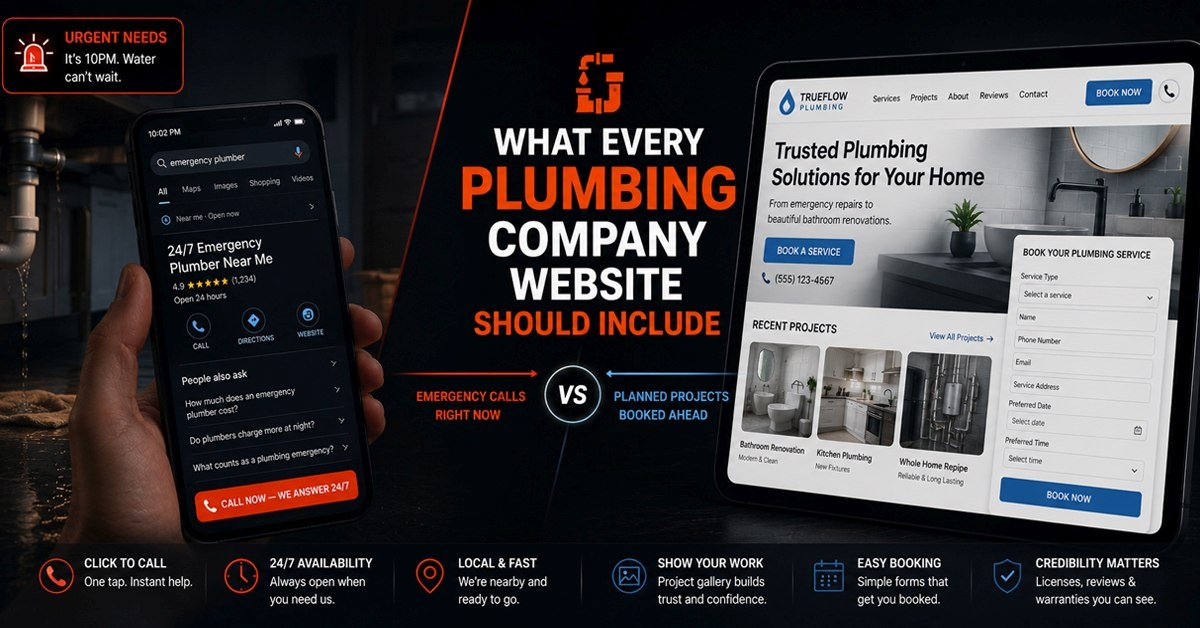
A plumbing website serves two very different visitors. The first is a homeowner with water coming through the ceiling at 9pm who needs to reach a plumber as fast as possible. The second is a homeowner planning a bathroom renovation who has three weeks to decide who to hire and wants to compare options carefully. Most plumbing websites are built for neither of them well. They have a homepage, a list of services, and a contact form that treats both visitors identically, regardless of how different their situations are.
The result is a website that converts neither visitor at the rate it should. The emergency caller cannot find a number fast enough and calls a competitor. The renovation planner cannot find enough depth to feel confident and moves on to a plumber whose website takes their project seriously.
This post is about what a plumbing website needs to serve both visitors, not as a checklist, but as an understanding of why each element matters and what it is doing for the person who encounters it.
Why Plumbing Website Visitors Behave Differently
A homeowner searching "emergency plumber" at 10pm is in a state of controlled panic. The problem exists right now, it is getting worse, and they need to solve it before it causes more damage. Their attention span for website content in that moment is measured in seconds, not minutes. They are scanning for a phone number and a service area confirmation, not reading about the company's history or looking at project photos.
A homeowner searching "bathroom renovation plumber" on a Saturday morning is in a completely different state. They have time, they have options, and they are evaluating carefully. They want to see completed projects, understand the process, read reviews, and get a sense of whether this plumber takes renovation work as seriously as they take emergencies.
The website that converts both of these visitors does not try to blend them into one experience. It gives the emergency visitor an unobstructed path to contact in the first five seconds, and it gives the planned visitor the depth and evidence they need to make a confident decision. The architecture needs to accommodate both without either getting in the other's way.
There is also a third dimension specific to plumbing that does not apply as strongly to roofing or HVAC: ambient consumer skepticism. Plumbing has a higher rate of consumer complaints and negative media coverage than most trades. Stories about inflated callout fees, unnecessary work, and unlicensed operators are common enough that many homeowners approach a new plumber with low-level wariness before the first call is made. A plumbing website that does not proactively address this skepticism through credentials, transparent fee information, and specific social proof leaves that wariness unresolved, and unresolved wariness does not convert.
Emergency Contact: When the Next Step Must Be Obvious
The phone number on a plumbing website is not a piece of contact information. For an emergency visitor, it is the entire purpose of the website. Everything else on the page is secondary to reaching that number as fast as possible. When the number is buried in the footer, accessible only through a contact page, or displayed as a non-tappable image on mobile, the website is making a distressed homeowner do extra work at the moment they can least afford it.
Emergency contact architecture on a plumbing website is built around one principle: the phone number should be reachable without scrolling, without navigating, and without reading anything. On mobile, that means a sticky tap-to-call button that follows the visitor as they scroll. On desktop, it means a prominently displayed number in the header that is visible before any other content registers. The number should be a clickable tel: link, not plain text, not an image.
One observation from plumbing website rebuilds worth stating directly: the most common emergency contact failure is not the absence of a phone number. The number exists. The failure is that reaching it requires an action the visitor in crisis will not take: scrolling to the footer, tapping a navigation menu, or navigating to a different page. The number is there but it is not available. That distinction is what the website design is responsible for resolving.
Trust Signals That Address Plumbing-Specific Skepticism
Licensing and insurance credentials matter in every home service trade. In plumbing they matter more, because unlicensed plumbing work is a genuine consumer risk and homeowners who have read about it are looking for visible evidence that this plumber is legitimate before they call.
License and Insurance on Every Service Page
The plumbing license number, insurance confirmation, and any relevant certifications belong on every service page and on the homepage, not only on an about page that many visitors never reach. A homeowner reading about blocked drain clearing should be able to confirm the plumber is licensed on the same page without navigating away. The credential at the moment of evaluation is reassurance. The credential somewhere else is a fact the homeowner may or may not find.
Transparent Callout Fee Information
This is the trust element most specific to plumbing and the one most plumbing websites avoid. Callout fees are a common source of negative plumbing reviews. A homeowner who called a plumber, paid a callout fee, received a quote they felt was inflated, and then paid the callout fee even when they declined the work, is a homeowner who writes an angry review. A plumbing website that states its callout fee structure transparently, even if it is "callout fee applies, credited against the job if work proceeds," does something most competitors will not do. It answers the question a skeptical homeowner is silently asking before they pick up the phone.
A website that says nothing about pricing is not neutral. To a homeowner who has had a bad experience with an opaque pricing process, silence on pricing is a yellow flag, not a blank slate. Transparent fee information addresses that flag directly and positions the business as one that does not hide costs, which is a genuine competitive advantage in a trade where hidden costs are a documented concern.
Reviews That Address What Plumbing Homeowners Actually Worry About
A homeowner hiring a plumber has specific concerns: whether the plumber will show up on time, whether the diagnosis will be honest, whether the quote will match the final invoice, and whether the work area will be left clean. Generic five-star reviews do not address these concerns. Reviews that specifically mention punctuality, accurate diagnosis, transparent pricing, and site cleanup speak directly to the doubts a homeowner carries into the decision.
When selecting which reviews to display on service pages, reviews that mention these specific elements should be prioritized over reviews that simply express satisfaction. "They quoted exactly what we paid, no surprises" is more persuasive for a price-skeptical homeowner than "great service, highly recommend."
Service Pages Built Around How Homeowners Actually Search
Homeowners do not search for "plumbing services." They search for the specific problem they have or the specific work they need done. A plumbing website with a single services page listing everything in a paragraph cannot appear in search for any individual service query, and cannot give a homeowner with a specific need the confidence that this plumber handles their particular situation regularly.
Emergency and Repair Services
Burst pipes, blocked drains, leaking taps, hot water system failures, and blocked toilets are distinct searches with distinct visitor intent. A homeowner with a burst pipe is in crisis. A homeowner with a slow-draining shower is not. A page for each service type can address the specific urgency level, likely cause, and typical resolution for that situation. That specificity tells the homeowner that this plumber understands what they are dealing with, before a single call is made.
Planned and Renovation Work
Bathroom renovations, kitchen plumbing, hot water system replacements, repiping, and gas fitting are planned purchases with longer decision timelines. A homeowner researching bathroom renovation plumbers is comparing options over days or weeks, not minutes. The service pages for these types of work need to reflect that. They should explain the process, the typical timeline, what the homeowner needs to prepare, and what to expect during and after the work. The depth of this content is what distinguishes a plumber who takes renovation work seriously from one whose website treats all jobs as emergency callouts.
Reviews on renovation service pages should specifically feature completed renovation projects. A homeowner planning a bathroom renovation is not reassured by reviews of emergency drain clearances. They want to see evidence that this plumber has done the type of work they are considering, done it well, and left clients satisfied with the process, not just the outcome.
Commercial Plumbing
A plumbing business serving both residential and commercial clients needs the website to separate these audiences clearly. A facilities manager evaluating a commercial plumbing contractor has different questions than a homeowner with a blocked drain. They want to know about service contracts, response time guarantees, compliance certifications, and the capacity to handle multi-site or multi-trade coordination. A website that mixes commercial and residential content without separation rarely speaks convincingly to either audience.
Online Booking for Planned Work
An online booking system for plumbing works differently depending on the type of work. For emergency callouts, phone is always the right contact path. For planned work like hot water system replacements, bathroom renovations, and scheduled maintenance, an online booking or appointment request system serves homeowners who want to schedule at a time that suits them rather than calling during business hours.
The booking form for planned plumbing work should collect enough information to allow the plumber to prepare for the job: the type of work required, the property type, whether any materials need to be sourced in advance, and the preferred appointment window. A form that collects this information upfront means the initial visit is productive rather than primarily diagnostic, which is a genuine service improvement that a homeowner researching options will notice and value.
For after-hours non-emergency enquiries, a booking form that confirms an appointment in the first available slot removes the uncertainty of waiting for a callback. A homeowner who submits a renovation enquiry at 8pm and receives a confirmation that the plumber will contact them the following morning between 8am and 10am has a clear expectation. A homeowner who submits a generic contact form has no idea when or whether they will hear back.
What This Looks Like Across Different Plumbing Operations
The Comparison: What Converts vs What Does Not
| Element | Built Around How Homeowners Actually Decide | Built Around How the Business Prefers to Present |
|---|---|---|
| Phone number | Sticky, tappable, visible in header without scrolling, click-to-call on mobile | In the footer, requiring scroll or navigation to locate |
| Emergency availability | 24/7 or hours stated clearly in the homepage hero section | Not mentioned, or buried in a services description paragraph |
| Service area | Suburb or city visible on homepage before any scroll, dedicated area pages for each territory | Mentioned once on the contact page with no dedicated area-specific content |
| License and insurance | License number and insurance confirmation on every service page where the decision is being made | Listed once on the about page that most visitors never reach |
| Callout fee | Stated transparently on the homepage and emergency service page, even if just the structure rather than a specific amount | Not mentioned anywhere, leaving the skeptical homeowner with unaddressed concern |
| Service pages | Individual pages per service type addressing the specific situation, urgency level, and what to expect | Single services list page that treats a burst pipe the same as a bathroom renovation |
| Reviews | On service pages, featuring comments specific to that service type: punctuality, honest diagnosis, transparent pricing | Homepage carousel of generic five-star ratings with no connection to specific services or concerns |
| Renovation work | Dedicated pages with process explanation, project gallery organized by type, and reviews from renovation clients | Listed as one item in a services paragraph with no depth or visual evidence |
| After-hours enquiries | Online booking for planned work that confirms an appointment slot without requiring a callback | Generic contact form with no indication of when or whether a response will arrive |
Frequently Asked Questions
Should a plumbing website show prices?
Not specific job prices, which genuinely vary too much by situation to display accurately. But callout fee information and the structure of how pricing works, whether the callout fee is credited against the job, what happens if a quote is declined, and whether there are after-hours or weekend surcharges, is information that reduces the trust deficit specific to plumbing. A homeowner who has read a horror story about unexpected callout fees is not reassured by a website that says nothing about pricing. They are reassured by one that addresses the question honestly. Transparent fee structure information, even without specific prices, signals that the business does not hide costs, which is a meaningful differentiator in a trade where hidden costs are a common complaint. Specific job prices for planned work like hot water replacements can be shown as a range rather than a fixed price, with a clear note that the exact cost depends on assessment. That is more useful to a homeowner researching options than no pricing information at all.
How many service pages does a plumbing website need?
The right number is the number of distinct service types the business offers where a dedicated page would serve a visitor searching specifically for that service. At minimum, a residential plumbing website typically benefits from separate pages for emergency and same-day plumbing, blocked drains, hot water systems, bathroom and kitchen plumbing, and general repairs and maintenance. Each of these represents a distinct search intent with a distinct visitor who has specific questions. A single services page listing all of these in a paragraph serves none of them as well as a dedicated page would. Additional pages for gas fitting, leak detection, or commercial plumbing make sense if the business actively works in those areas. Pages for services the business does not regularly perform or cannot deliver at the same quality as its core offering are not worth creating. Our post on why contractor websites get traffic but no calls covers the structural reasons service pages that are too thin or too generic fail to convert the visitors they attract.
What is the most important difference between a plumbing website and a website for other trades?
The combination of emergency urgency and consumer skepticism is what makes plumbing website design genuinely different from roofing or HVAC. A roofing website can afford to be thorough and detailed because the homeowner has time to read. A plumbing website has to serve a visitor who may have no time at all. The emergency contact path has to work before the visitor reads a single word of content. The trust signals have to be visible without requiring the visitor to seek them out, because a skeptical homeowner in a hurry will not go looking for a license number on an about page they have not navigated to yet. At the same time, a plumbing business that only optimises for emergency visitors misses the significant revenue from planned work, where the decision timeline is longer and the website has more time to make its case. Our post on what every HVAC company website should include covers the dual visitor architecture in more depth, since HVAC and plumbing share the urgent-versus-planned split more than any other home service trades do.
Is Your Plumbing Website Serving Both the Emergency Caller and the Renovation Planner?
We build websites for plumbing businesses and home service contractors designed around how homeowners actually decide who to call. If your current site is losing visitors before they reach your contact path, let us take a look.