
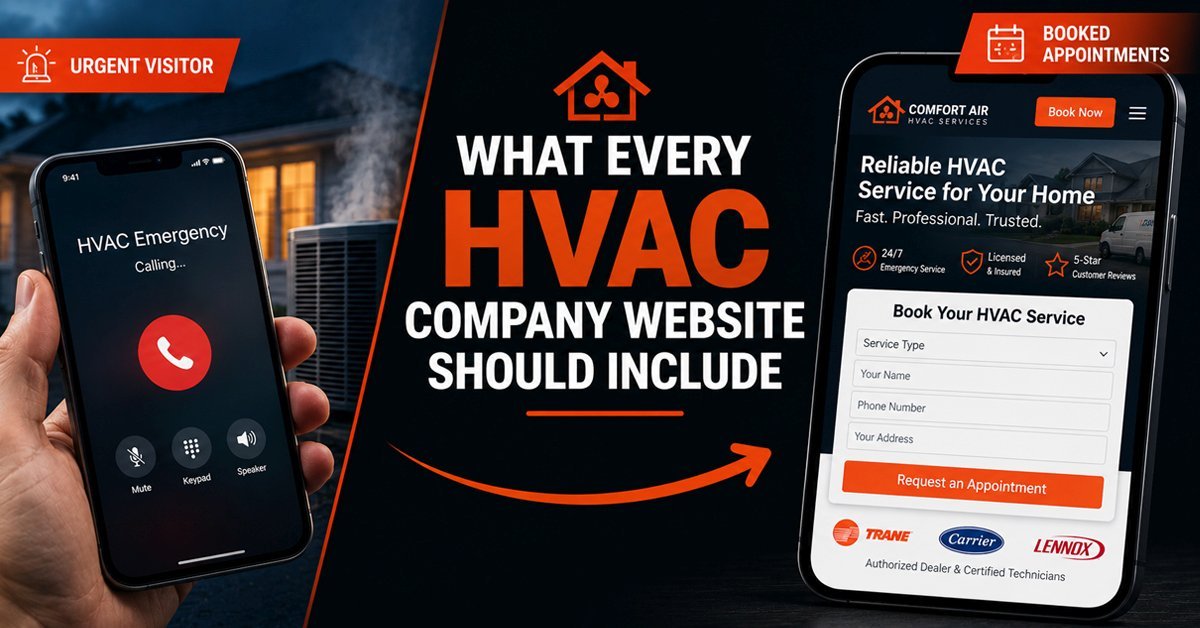
HVAC websites serve two kinds of visitors who behave completely differently. The first is a homeowner with a system that is not working right now. Their AC stopped in the middle of summer, or their furnace failed overnight. They are on a phone, they have a problem, and they need to know in ten seconds whether this company can help today. The second is a homeowner planning a replacement or upgrade. They have time, they are comparing options, and they are evaluating experience, brands, efficiency ratings, and pricing.
Most HVAC websites are built for the second visitor and fail the first one entirely. The emergency contact path requires navigation. The phone number is in the footer. There is no same-day service information visible without reading through three pages. By the time an urgent visitor has done all of that, they have already called a competitor whose website answered their question in the first five seconds.
A well-built HVAC website serves both visitors without sacrificing either. Here is what that requires.
Why HVAC Website Visitors Behave Differently From Other Home Service Customers
A homeowner searching for a roofer usually has a few days to decide. A homeowner searching for an HVAC contractor in July at 7pm with a failed AC unit does not. The urgency changes everything about how the website needs to work. Every extra click, every slow page load, every piece of missing information sends that visitor to the next result. They are not being picky. They are in discomfort and they want the first company that makes it easy to say yes.
Understanding this split between urgent and planned visitors shapes every architectural decision in an HVAC website. The two visitor types need different things from the same site, and the website needs to serve both without creating confusion about where either should go.
The website architecture that serves both starts with the urgent visitor in the most visible position, because urgency is time-sensitive and a missed urgent visitor cannot be recovered, and then provides enough depth in service pages and content to satisfy the planned visitor who stays longer.
Emergency Service: The Most Important Section on an HVAC Website
An HVAC company that offers emergency or same-day service and does not make that immediately visible from the homepage is leaving its highest-value visitor type without the information they need to choose. Emergency HVAC calls convert at a higher rate than any other contact type, because the visitor has already decided they need a contractor. The only decision left is which one.
Emergency service information on an HVAC website needs to be visible in the homepage hero, available as a sticky element on mobile scroll, and linked to a direct phone call, not a contact form. A homeowner with a system failure will not complete a form at 9pm. They will call. The website needs to make that call as easy as one tap from wherever they are on the site.
If the company offers 24-hour emergency service, that information belongs in the header alongside the phone number, not in a footer paragraph below the fold. If same-day service has specific conditions, those should be stated clearly: "Same-day service available for calls received before 2pm" sets an expectation that a homeowner can act on. "We offer same-day service" without any detail does not.
Service Pages Built Around What Homeowners Actually Search For
A single "Services" page listing AC repair, furnace installation, heat pump replacement, and duct cleaning in a bulleted list does not give any single service enough depth to rank well or to convince a homeowner who needs that specific service that this company is the right choice. Each service needs its own page built around the questions a homeowner with that specific need would ask.
AC Repair and Maintenance
A homeowner searching for AC repair wants to know what problems the company diagnoses and fixes, how quickly they can respond, what a typical repair visit involves, and roughly what common repairs cost in terms of parts and labor categories. A service page that answers those questions gives the homeowner enough to proceed with confidence. One that says "we repair all makes and models" without any further detail leaves the homeowner with the same unanswered questions they started with.
New System Installation
A homeowner planning a new HVAC installation is making one of the larger home investments they will make in a given year. They want to know which brands are available, what efficiency ratings are offered, how the installation process works, how long it takes, and what happens after installation in terms of warranty and follow-up. A dedicated installation page that walks through the process, the brand options carried, and what the homeowner should expect gives the planned visitor exactly what they need to move from research to a consultation request.
Maintenance Plans and Service Agreements
This is the section most HVAC websites either omit entirely or hide in a dropdown menu. A maintenance plan or service agreement is a recurring revenue relationship for the HVAC company and a genuine value proposition for a homeowner who wants their system serviced regularly without having to remember to schedule it. A dedicated page explaining what the plan includes, how often visits occur, what priority status it provides for emergency calls, and how to sign up gives a homeowner who is already a customer a reason to deepen the relationship, and gives a new homeowner a reason to choose this company over one that does not offer structured ongoing care.
The maintenance plan page is also valuable from a website architecture perspective because it serves a different search intent than repair or installation pages. A homeowner searching for "HVAC maintenance plan" is not in emergency mode. They are thinking ahead. A page built for that specific intent catches a visitor that a generic services page would miss entirely.
Manufacturer Certifications and Brand Partnerships
An HVAC contractor certified by Carrier, Lennox, Trane, Daikin, or American Standard has been trained and vetted by that manufacturer to install and service their systems. For a homeowner who has researched which brand they want or who will be buying a brand-specific system, that certification is a direct qualifier. If the company is a Carrier Factory Authorized Dealer or a Lennox Premier Dealer, that information should be prominently visible on the homepage and on the relevant installation service pages.
Manufacturer certifications communicate two things a homeowner cares about: that the technicians have been trained specifically on those systems, and that manufacturer warranty terms may be enhanced when the system is installed by a certified contractor. The second point matters for a homeowner making a significant investment in a new system. An enhanced warranty that is only available through a certified installer is a real differentiator, and it belongs on the installation page where the homeowner is making the decision, not on an about page they may never visit.
Beyond certifications, NATE certification (North American Technician Excellence) is the industry-wide technical credential that demonstrates technician competency regardless of brand. If technicians on staff hold NATE certification, it should be visible on the site. A homeowner who does not know what NATE certification means will not know to look for it. A homeowner who does know what it means will look for it specifically, and not finding it on a competitor's site is a quiet reason to choose the company that displays it.
Online Booking and Appointment Scheduling
A homeowner who wants to schedule a maintenance visit or a non-emergency repair consultation at 10pm on a Saturday should be able to do that without calling the office during business hours. An online booking system that accepts appointment requests, confirms availability, and sends an automated confirmation with the technician arrival window removes the barrier of business-hours-only scheduling for the planned visitor who is ready to act outside of those hours.
Online booking for HVAC works best when it is connected to the company's dispatch or scheduling system rather than operating as a separate form that someone processes manually the following morning. A booking request that goes into a queue and gets a callback the next business day is not meaningfully different from a contact form. An integrated booking system that confirms an appointment slot immediately is a genuine convenience that a homeowner who has been researching HVAC companies will notice and value.
For emergency calls, online booking is the wrong tool. The emergency path should always lead to a direct phone call. Online booking serves the planned visitor who is not in a hurry. The website needs both paths, and neither should be mistaken for the other.
Energy Efficiency, Rebates, and Financing
A new HVAC system is a significant home expense, and many homeowners do not know that utility rebates, manufacturer rebates, and financing options may be available to reduce the out-of-pocket cost. An HVAC website that does not address these options is leaving homeowners who might have proceeded with a consultation request wondering whether they can afford to do so.
The efficiency and financing section works best when it is placed on the installation service page, near the point where a homeowner is deciding whether to request a quote. A paragraph that says "financing available, ask us for details" is almost useless. A section that explains what financing terms are typically available, mentions any active utility rebate programs in the service area, and notes the efficiency ratings of the systems installed gives a homeowner the information they need to make a decision rather than another reason to delay.
Energy efficiency ratings, specifically SEER ratings for cooling systems and AFUE ratings for furnaces, matter to a homeowner who is comparing options. A website that uses these terms without explaining them briefly, or that does not mention them at all, is missing an opportunity to demonstrate technical knowledge and help a homeowner understand what they are buying. The explanation does not need to be long. One sentence that contextualizes what a higher rating means for monthly energy costs is enough to make the information useful.
Reviews That Address the Specific Concerns HVAC Homeowners Have
A homeowner hiring an HVAC contractor has a specific set of concerns that a homeowner hiring a painter or a landscaper does not. They are letting someone access mechanical systems in their home, they are worried about being oversold on a replacement when a repair would do, and they are concerned about whether the technician will explain what was found and what was done in terms they can understand. Reviews that address these concerns directly are more persuasive for an HVAC website than a high volume of generic five-star ratings.
When displaying reviews on service pages, prioritize reviews that mention honest diagnosis, clear explanation of what was found, fair pricing relative to the problem, and follow-up after the service visit. A review that says "they told us we only needed a capacitor replaced when we expected to need a whole new unit, saved us a lot of money" communicates something about this company's integrity that no marketing copy can replicate. Reviews that address the specific worry a homeowner has at the moment they are on a specific service page are significantly more persuasive than a generic testimonials carousel on the homepage.
What This Looks Like Across Different HVAC Operations
The Comparison: HVAC Website Elements That Convert vs Those That Do Not
| Element | Built Around How Homeowners Actually Decide | Built Around How the Business Prefers to Present Itself |
|---|---|---|
| Emergency contact | Phone number in header, tappable, visible without scrolling, sticky on mobile | Phone number in footer, requiring scroll or navigation to find |
| Same-day service | Stated clearly in the homepage hero with specific availability information | Mentioned as a general capability without details on when or how to access it |
| Service pages | Individual pages per service with depth on what that service involves and what the homeowner should expect | Single services page listing all offerings in a paragraph or bulleted list |
| Manufacturer certifications | Displayed on homepage and installation service pages with a brief explanation of what they mean | Mentioned once on the about page without context about why it matters |
| Maintenance plans | Dedicated page with clear inclusions, sign-up path, and priority emergency benefit stated | Mentioned in a paragraph on the services page with no dedicated page or sign-up option |
| Online booking | Integrated scheduling for consultations and maintenance, works outside business hours | Contact form only, requiring a callback during business hours to confirm the appointment |
| Financing | Specific information on the installation page: terms, process, and any active rebates | Vague mention of financing availability with no detail on terms or how to apply |
| Reviews | Service-page-level reviews addressing honest diagnosis, fair pricing, and technician communication | Homepage carousel of generic five-star ratings with no connection to specific service concerns |
Frequently Asked Questions
Should an HVAC website have separate pages for heating and cooling services?
Yes, for several reasons. A homeowner with a furnace problem searches differently than a homeowner with an AC problem, and a page dedicated to each service can address the specific questions that visitor has without requiring them to filter through content about the other system. Separate pages also allow each service to appear in search results for the specific queries a homeowner uses when they have that particular need. A combined heating and cooling page typically ranks adequately for neither set of queries. The minimum structure for an HVAC website that wants to convert well across both service types is: dedicated AC repair page, dedicated furnace repair page, dedicated AC installation page, dedicated heating installation page, and a maintenance page that covers both systems. Each page should be built around the questions a homeowner with that specific need is asking, not around the company's internal service categories.
How should an HVAC website handle after-hours service requests?
The approach depends on whether the company offers true 24-hour emergency response or only handles after-hours calls during a limited window. If 24-hour emergency service is available, the phone number should be the primary after-hours contact path with a clear statement that someone will answer at any hour. A contact form as the only after-hours option sends a visitor who needs help tonight to wait until tomorrow, which in an emergency means they have already called someone else. If after-hours response is limited, being honest about the response window is better than implying availability that does not exist. A homeowner who submits a form expecting a callback in two hours and receives one the following morning will not become a loyal customer. An after-hours booking system that confirms a morning appointment slot is a reasonable middle ground for non-emergency requests that come in outside business hours.
What is the most important page on an HVAC company website?
The homepage is the most important page for urgent visitors because it is typically where an emergency search lands first. But the AC installation or furnace installation service page is usually the highest-value conversion page for planned visitors, because it serves the homeowner who is deciding on a significant purchase and has the most specific questions. The maintenance plan page is often the most underinvested page relative to its revenue potential. For HVAC companies where a large share of revenue comes from recurring service agreements, investing as much in the maintenance plan page as in the installation pages typically produces a meaningful improvement in the share of website visitors who convert to plan customers rather than one-off repair or installation enquiries. Our contractor website guide covers how to think about page priority across the full home services website structure.
Is Your HVAC Website Serving Both the Urgent Visitor and the Planned Replacement Customer?
We build websites for HVAC companies and home service businesses designed around how homeowners actually decide who to call. If your current site is not converting the traffic it receives, let us review it.