
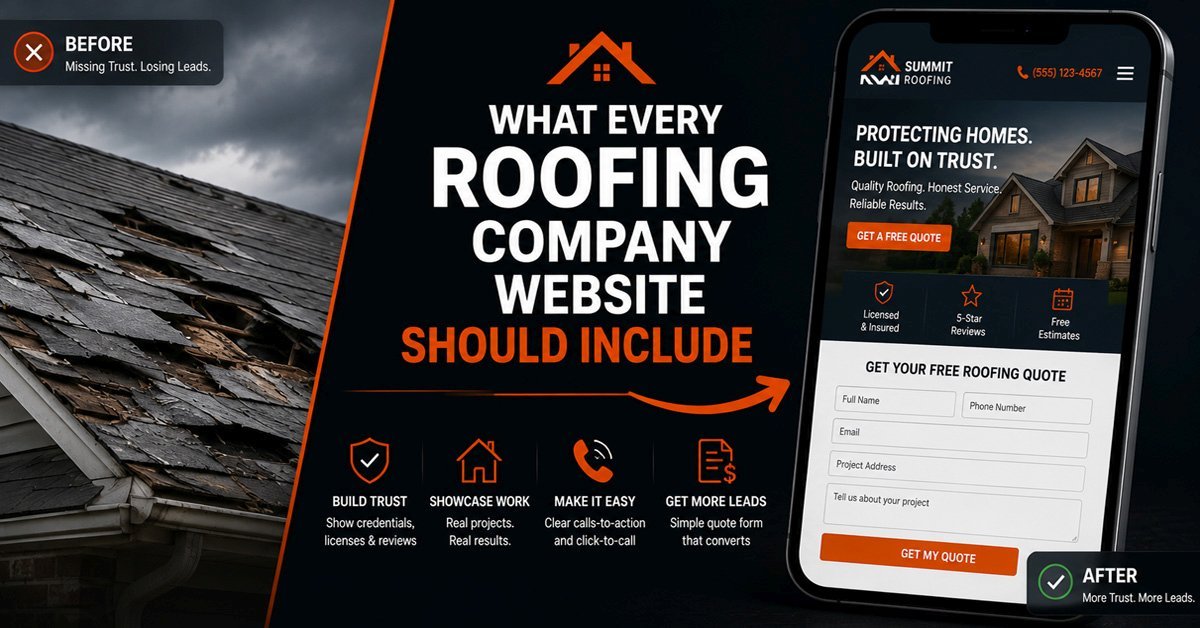
Most roofing websites we see before a rebuild share the same problem. The site has a homepage, a services page, some photos, and a contact form. It looks like a roofing company. What it does not do is give a homeowner enough reason to choose this roofer over the three others they found in the same search. The information they need to make that decision is either missing, buried, or presented in a way that makes it harder to find than it should be.
Roofing is a high-trust, high-stakes purchase. A homeowner calling a roofer is not shopping for something they can return. They are deciding who to trust with their home's most important protective system, often at a stressful moment when water is already coming through. The website needs to answer their questions quickly and give them confidence before they ever pick up the phone.
This post is about what that actually requires, built around how homeowners think when they are evaluating a roofer, not a generic feature list.
How Homeowners Choose a Roofing Contractor
Before deciding what to build on a roofing website, it helps to understand exactly what a homeowner is thinking when they land on it. In our experience building websites for home service businesses, roofing visitors typically want answers to five questions, usually in this order:
Every section of a roofing website should exist to answer one of these five questions. If a section does not serve any of them, it is adding length without adding value. The structure below is built around answering these questions in the order a homeowner naturally asks them.
Make Your Service Area Obvious From the Start
A homeowner who cannot tell within seconds whether a roofing company works in their area will not read further. They will go back to the search results and find someone who makes it clear. Service area information belongs on the homepage, visible without scrolling, not only on a contact page or buried in the footer.
For roofing companies serving multiple cities or counties, dedicated service area pages give each territory its own presence in search. A homeowner searching for a roofing contractor in a specific city will find a page that speaks directly to that location rather than a generic homepage that does not mention it. These pages also let the roofing company rank for location-specific searches across its full operating territory, not just in the city where the main address is registered.
The common mistake is creating dozens of service area pages with nothing but the city name swapped into a template. Pages like that do not serve homeowners and they do not rank well. A service area page needs to include the specific services offered in that location, any relevant local context, and a clear way to request a quote for work in that area. Ten genuinely useful service area pages are worth more than fifty that look identical with a different city name.
Show Real Roofing Projects, Organized So Homeowners Can Find What They Need
Roofing is one of the most visual trades in home services. A homeowner considering a roof replacement cannot evaluate your workmanship from a description. They can evaluate it from photos. A gallery of completed projects is not an optional feature on a roofing website. It is one of the primary reasons a homeowner decides to call.
The organization of the gallery matters as much as the content. A single page of fifty unfiltered photos is difficult to use. A homeowner looking for examples of metal roof installations on residential homes cannot find them in a mixed gallery of commercial flat roofs, storm damage repairs, and shingle replacements. The gallery should be filterable by roof type, material, and ideally by the type of work (replacement, repair, new construction). This allows a homeowner to quickly find examples relevant to their specific situation.
Before and after photos are particularly powerful in roofing because the contrast is immediate and clear. A damaged or worn roof beside its replacement tells the entire story of what the company does without requiring the homeowner to read anything. Each gallery item should link directly to a quote request form, because the moment a homeowner is impressed by a project is the moment they are most likely to act.
What the Gallery Should Not Be
A gallery built from stock photos or manufacturer images does not show the company's actual work. Homeowners recognize this, and a gallery that looks like it was populated from a supplier's marketing material reduces trust rather than building it. Every photo in a roofing gallery should be from a real project completed by the company. The quality of the photography matters less than the authenticity.
Build Trust Before the Homeowner Calls
A homeowner evaluating a roofing contractor wants to know, before they pick up the phone, that the person they are calling is legitimate. In the roofing industry specifically, where storm-chasing contractors and unlicensed operators are genuinely common, the bar for establishing credibility is higher than in most trades. The website needs to address this directly rather than assuming the homeowner will give the benefit of the doubt.
Licenses and Insurance on Service Pages, Not Just the About Page
The license number, insurance confirmation, and any relevant bonding information belong on every service page, not only on an about page that many homeowners never visit. A homeowner reading about roof replacement services should be able to see the roofing license and insurance information on that same page. Putting it only on an about page means the homeowner who is on a service page, which is where most homeowners spend their time, never sees the information that would address their primary trust question.
Manufacturer Certifications Communicate More Than You Might Expect
A GAF Master Elite certification, an Owens Corning Preferred Contractor designation, or a CertainTeed ShingleMaster credential tells a homeowner two things simultaneously. First, that this contractor has been vetted by a major manufacturer and meets their installation standards. Second, that the homeowner may be eligible for an enhanced warranty on materials that goes beyond what an uncertified installer can offer. These certifications are among the most underused trust signals on roofing websites, typically mentioned once in passing when they should be prominently displayed on every relevant service page.
Reviews That Mention the Specific Things Homeowners Worry About
A homeowner hiring a roofer worries about a specific set of things: whether the crew will show up when they said they would, whether the site will be cleaned up properly after the job, whether the workmanship will hold up, and whether the finished roof looks as good as the photos promised. Reviews that speak to these specific concerns are more persuasive than generic five-star ratings. When displaying reviews on the website, reviews that mention crew communication, site cleanup, and the finished result should be prioritized over generic positive sentiment.
Reviews should be visible on service pages, not just a standalone testimonials page. A homeowner on the roof replacement service page should see reviews from homeowners who had roof replacements, not only on a separate page they would have to navigate to find.
Make Emergency Repair Easy to Find
A homeowner who has just noticed water coming through their ceiling after a storm is not in a research mindset. They are in a problem-solving mindset, and they need to find a roofer who can respond quickly. If the emergency repair service is buried three clicks deep, or listed as a sub-item in a dropdown menu, the website is working against the very homeowner who has the most urgent need.
Emergency roof repair, where offered, should be immediately visible from the homepage. This might be a sticky banner during storm season, a prominent section in the homepage hero, or a dedicated emergency contact path separate from the standard quote request form. The key is that a homeowner with an active leak can reach an emergency contact option within seconds of arriving on the site, not after reading through service descriptions to find it.
The emergency contact path itself should be different from a standard quote form. A homeowner with water coming through their ceiling is not going to complete a detailed form. They want a phone number to call. An emergency contact that leads with a tappable phone number, followed by a brief form for after-hours situations, matches the actual behavior of a homeowner in that moment.
Show Financing Options if You Offer Them
A full roof replacement is one of the largest unplanned home expenses most homeowners face. For many, the question of whether they can afford it is as pressing as the question of who to hire. A roofing company that offers financing and buries that information in a paragraph at the bottom of a contact page is losing homeowners who would have proceeded if they had known financing was available.
Financing options belong on the roof replacement service page and on the homepage, near the quote request call to action. The goal is not to lead with financing as if it is the main pitch, but to make sure a homeowner who is concerned about affordability sees the option before they decide not to reach out. A homeowner who learns financing is available after they have already disqualified the company for price reasons is a lead lost unnecessarily.
The financing section should explain what is available in plain terms: whether it is a third-party partner like GreenSky or a direct arrangement, what the typical approval process looks like, and how to find out if they qualify. It does not need to be long. It needs to answer the question a cost-conscious homeowner is silently asking.
A Quote Form Built for Roofing, Not a Generic Contact Form
A generic contact form with a name, email, and message field is not a quote request tool. A homeowner who fills it out writes a paragraph describing their roof. The roofer receives it, calls to gather the information actually needed to estimate the job, and by the time that conversation happens the homeowner has already received a proposal from a competitor whose form asked the right questions upfront.
A roofing-specific quote form collects: roof type and approximate age, the nature of the issue (replacement, repair, inspection, storm damage), property type, approximate size if known, and preferred contact time. This takes a homeowner two minutes to complete on a phone and gives the roofing company everything needed to call back with a meaningful response rather than another round of information gathering.
The phone number should be visible as a tappable link in the header of every page, always. Many homeowners will still prefer to call rather than complete a form, especially for urgent situations. The form and the phone number serve different homeowners at different moments. Both should be immediately accessible without scrolling or navigating.
Make the Website Fast on Mobile
A homeowner who notices a problem with their roof and searches for a contractor on their phone will not wait for a slow website to load. A roofing website that takes more than three seconds to load on a mobile connection loses visitors before they see anything at all. Those lost visitors do not appear in analytics as bounces. They appear as sessions that never started.
The most common causes of slow roofing websites are unoptimized photos, since roofing galleries often contain dozens of high-resolution images uploaded directly from a phone or camera without compression, and themes that load unnecessary code on every page. Fixing these typically requires a developer, but the impact is immediate and affects every visitor the site will ever receive.
Beyond load speed, the mobile experience needs to work correctly for the actions a homeowner would take on a phone: reading service descriptions, viewing gallery photos, tapping a phone number to call, and completing a quote form. A site that is functional on desktop but breaks on mobile is invisible to a significant share of its potential customers.
What a Well-Built Roofing Website Looks Like Across Different Business Types
The Comparison: What Converts vs What Does Not
| Element | Built for the Homeowner's Decision | Built for the Business Owner's Preference |
|---|---|---|
| Homepage hero | Service type, coverage area, and primary action visible without scrolling | Large company name, tagline, and stock photo of a roof with no specific information |
| Service area | Dedicated pages per city with genuinely useful content and a local quote form | A list of cities in a footer paragraph with no individual pages |
| Gallery | Filtered by roof type and material, before and after comparisons, links to quote form | Unfiltered photo grid, no organization, no path to contact |
| Credentials | License, insurance, and manufacturer certifications on every service page | Credentials on about page only, or not displayed at all |
| Reviews | Displayed on service pages with quotes mentioning specific workmanship details | Generic star rating on homepage, full reviews only on Google |
| Emergency contact | Visible from homepage, dedicated page, direct phone path for urgent situations | Listed as one item in a services dropdown, same contact form as everything else |
| Financing | Mentioned on roof replacement page and near quote CTA | Not mentioned, or buried in FAQs that most homeowners never reach |
| Quote form | Roofing-specific fields, completes in under two minutes on mobile | Generic name, email, and message with no structure or guidance |
| Phone number | Tappable in header on every page, sticky on mobile scroll | In footer only, visible by scrolling to the bottom of the page |
What a Roofing Website Does Not Need
Being clear about what to leave out matters as much as knowing what to include. A roofing website does not need an animated homepage hero that delays loading by several seconds and provides no useful information about the business. It does not need a blog filled with general home improvement articles that attract homeowners who are not looking to hire a roofer. It does not need every social media platform linked in the header competing with the phone number and quote form for the homeowner's attention.
It also does not need a page telling homeowners how to maintain their roof themselves. Content that helps homeowners solve their own problems is not content that drives roofing enquiries. Every page and section should connect to the homeowner's decision to hire someone, not to their ability to avoid hiring someone.
Frequently Asked Questions
How many pages does a roofing company website need?
The minimum for a roofing company that wants to generate enquiries from its website is: a homepage, separate pages for each major service (replacement, repair, inspection, emergency if offered), service area pages for each city served, a gallery, a reviews or testimonials page, and a contact or quote request page. That is typically eight to fifteen pages depending on how many services and service areas are involved. Adding more pages beyond that is only useful if each page has a clear purpose serving a homeowner's specific question. Pages added for the sake of adding content, without a clear reason a homeowner would land on them and find them useful, typically dilute the site's relevance rather than strengthen it.
Should a roofing company use a website builder or a custom-built site?
A website builder can produce a functional roofing website, and for a very small roofing business with limited service offerings and a tight budget, it is a reasonable starting point. The limitations appear as the business grows. Website builders restrict the ability to create genuinely unique service area pages, build custom quote forms with roofing-specific fields, integrate live review feeds, or optimize page performance for the gallery-heavy content roofing sites rely on. A roofing company that generates meaningful revenue from its website and needs it to work reliably across dozens of service area pages, multiple service types, and an extensive gallery will find a WordPress site built specifically for those requirements outperforms a builder site for those specific needs. Our broader comparison of why contractor websites get traffic but no calls covers the specific structural problems that often originate from sites built without the conversion goal in mind.
Is it worth having separate pages for each roofing material?
Yes, when done correctly. A homeowner with a metal roof searches differently than a homeowner with an asphalt shingle roof or a flat commercial membrane. A dedicated page for metal roofing, asphalt shingle replacement, tile roofing, or flat roof repair allows the site to address the specific questions each type of homeowner has, and each page can appear in search results for the material-specific queries that homeowner used. The quality standard matters here: a page for metal roofing needs to contain genuinely useful information about metal roof installation, repair, and what a homeowner should know before replacing their metal roof, not just a few sentences with "metal" added to the page title. If the page does not add meaningful information beyond what the general roofing service page already says, it is not worth creating as a separate page. Our home services website development service covers how we approach this kind of service page architecture for roofing and other trades.
Is Your Roofing Website Clearly Showcasing Your Services and Making It Easy to Get a Quote?
We build websites for roofing companies and home service businesses designed around how homeowners actually choose a contractor. If your current site is not generating the enquiries your work deserves, let us take a look.