
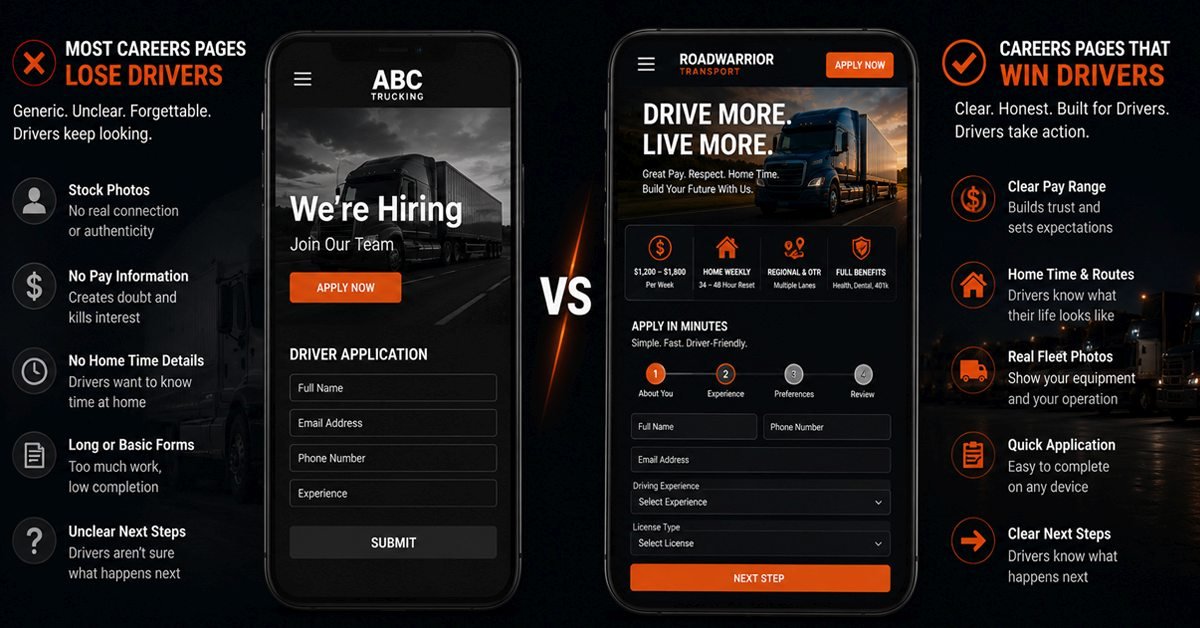
A driver looking for a new carrier does not call every company on a list. They search, they visit websites, and they form an impression within the first two minutes of landing on a page. If the page does not answer the questions they are carrying, they leave. They do not call to ask. They do not fill out the contact form. They move to the next result.
This is a website problem disguised as a hiring problem. The driver shortage is real, and competition for qualified CDL drivers is significant across the industry. But the carriers who are consistently losing drivers at the website stage are not losing them because of the shortage. They are losing them because their website is failing to answer the five questions every driver asks before they decide whether to apply.
The rest of this post works through each failure point in the driver journey, explains what the website needs to provide at each stage, and covers the functionality that separates a careers page from a driver recruitment system. We have built transportation websites and driver application workflows, and the failures we see most often are not about design. They are about content architecture and what the site leaves unanswered.
Two Audiences, One Website: Why Driver Content Gets Left Behind
A trucking company website serves two completely different audiences. Shippers need to know whether this carrier can move their freight, on their routes, with the right equipment. Drivers need to know whether this company is a good place to work, what the pay structure looks like, and how to apply. These two audiences have nothing in common except that they both visit the same website.
The problem is not that both audiences exist. The problem is how most trucking websites handle it. Shipper-facing content dominates because winning freight is the immediate revenue priority. Driver recruitment gets a single page, usually titled "Careers" or "Drive for Us," with a brief paragraph and an application form. The shipper who visits the site finds detailed service area pages, equipment specs, and rate inquiry forms. The driver finds a paragraph.
As we covered in our post on how trucking companies get more freight leads from their website, the architecture solution is to separate these two audiences at the navigation level so neither has to wade through content written for the other. The shipper path leads through freight services and equipment capability. The driver path leads through pay, home time, equipment, and application. The same principle applies here: driver recruitment content needs its own section with the same depth that shipper content receives, not a single underdeveloped page.
How a Driver Actually Evaluates a Carrier Online
Understanding what a driver does when they land on a trucking website makes it immediately clear why most careers pages fail. A driver evaluating a carrier is not passively browsing. They are actively researching whether this company is worth their time. Most drivers in the market for a new position are already employed. They are not desperate. They are selective.
The five questions a driver is asking map directly to specific website content. When the content is missing, the question goes unanswered, and the driver moves on.
Will I actually get home? Home time is the number one concern for most drivers, particularly those with families. A website that mentions "great home time" without specifying what that means in practice is not answering the question. Drivers want to know the route type (regional, OTR, local), the typical schedule, and whether the home time commitment is stated explicitly or left vague on purpose.
What equipment will I drive? Drivers care about equipment because it directly affects their working conditions, their safety, and their earning potential. Equipment age, maintenance standards, and cab configuration matter. A driver who has spent years in a late-model truck with a comfortable sleeper will not apply to a carrier whose website shows fleet photos from a decade ago with no year or specification information.
Is this company legitimate? A driver considering a carrier they have not worked with before is assessing risk. DOT and MC numbers, years in operation, fleet size, and any visible operational history are the signals that answer this question. A website with a generic header, stock photos, and no verifiable information reads as a carrier that either does not know how to present itself or has something to hide. Either way, the driver does not apply.
How complicated is the application? Drivers are practical. If the application requires creating an account, uploading documents in formats they do not have, or completing a multi-page form that takes forty minutes on a desktop computer, most will abandon it. The friction between interest and submission is where most applications are lost.
Will anyone respond? A driver who submits an application and hears nothing for a week has already taken a job elsewhere. The confirmation experience after submission tells the driver whether this carrier is organised and responsive, or whether their application has disappeared into a general inbox that nobody monitors.
The Trust Gap: What Drivers Actually See
The trust a driver forms about a carrier in the first two minutes of visiting a website is not built through marketing copy. It is built through evidence. Two carriers can operate identical trucks on identical routes at identical pay, and one will consistently receive more applications because its website presents evidence while the other presents claims.
The difference is not design. Carrier A may have a more visually polished website than Carrier B. The difference is that Carrier B has answered every question a driver is asking, and Carrier A has answered none of them. A driver who spends two minutes on each site will apply to Carrier B and move on from Carrier A, regardless of which company actually offers better working conditions.
The trust signals that matter most on a driver recruitment website are not testimonials or certifications, though those help. They are the specifics: a stated pay range, an explicit home time policy, real fleet photos, and a clear application timeline. Specificity is the trust signal. Vagueness is the trust failure.
The Driver's Journey Through Your Website
Mapping the driver's journey through a trucking website reveals exactly where most carriers lose applicants. Each stage corresponds to a website element. When that element is missing or inadequate, the driver does not proceed to the next stage.
The journey diagram reveals something important: most trucking websites lose drivers before stage four. The driver arrives, cannot find explicit pay information or a clear home time policy, and leaves without reaching the application. The application form improvement that many carriers focus on is solving the wrong problem. The application is stage five. The content failures are in stages two and three.
Mobile-First Is Not Optional for Driver Recruitment
Freight inquiry forms are completed at desks. Driver applications are completed on phones. This is not a generalisation. It reflects where drivers physically are when they research carriers and decide whether to apply. A driver on a break at a truck stop, sitting in a cab waiting for a load, or at home after a long week is not opening a laptop to browse carrier websites. They are on their phone.
A driver recruitment page that has not been built with mobile as the primary experience is losing applications before they start. The failures are predictable: form fields that are too small to tap accurately on a touchscreen, file upload buttons that do not connect to the phone's document or photo library, multi-column layouts that collapse poorly on narrow screens, and application flows that require desktop-only features like right-click to attach a document.
The specific areas where mobile optimisation matters most for driver recruitment are the application form, the navigation to the careers section, and the pay and home time content that the driver needs to read before they decide to apply. If any of these three elements are difficult to use on a phone, the conversion rate for the recruitment page will reflect it. We have reviewed transportation websites where the careers page performed well in desktop testing and lost more than half of potential applicants on mobile because the form was not built for touch input.
What a Mobile-Optimised Driver Application Looks Like
A driver application that works on mobile has single-column form fields with generous tap target sizes, a file upload field that opens the phone's native file picker, a progress indicator if the form has multiple steps so the driver knows how much remains, and a submit button that is large enough to tap without missing. The form should not require the driver to scroll horizontally at any point, and no field should require text input that would realistically take more than thirty seconds to type on a touchscreen.
The content before the form matters equally. Pay information, home time policy, and equipment details should be scannable on a small screen without requiring the driver to zoom in or read three-column layouts that have collapsed into an unreadable stack. A driver who cannot easily read the information they need to make a decision will not scroll further to reach the application.
What the Driver-Facing Pages Actually Need to Say
Beyond the structural and mobile requirements, the content on a driver recruitment website needs to answer the five driver questions with specificity. Vague language on any of the five points signals a carrier that either does not understand what drivers need to know, or is deliberately obscuring information that drivers would find unfavourable.
Pay Structure and Earning Potential
Pay is the most-searched information on any carrier's careers page and the most frequently left vague. "Competitive pay" and "top pay in the industry" communicate nothing. A driver who has been researching carriers for two weeks has read those phrases on fifty websites and has learned to treat them as noise.
The alternative is not necessarily publishing a single CPM rate. It is publishing the structure clearly enough that a driver can estimate their realistic weekly earnings. For a CPM carrier, that means stating the rate range for drivers at different experience levels and an indication of average weekly miles. For percentage carriers, it means explaining the percentage and what the average weekly gross looks like in practice. For salary positions, it means stating the annual or weekly figure. Any of these approaches gives a driver something to evaluate. Vague language gives them nothing, and nothing produces no application.
Home Time Policy
Home time is stated in terms that a driver's family can understand, not in terms that sound favourable in a recruitment context. "Home on weekends" means different things to different carriers: home every weekend, home most weekends, home some weekends. A driver who has left previous positions over home time promises that were not kept is reading these details carefully. A website that states "home weekly by Saturday, out Monday" is making a specific, verifiable commitment. A website that says "great home time" is making no commitment at all.
Equipment Age and Maintenance
Equipment information on a driver recruitment page serves a different purpose than equipment information on a shipper-facing page. Shippers want to know trailer type and capacity. Drivers want to know what truck they will actually operate every day. The relevant information for a driver is the average age of the fleet, whether trucks are assigned to individual drivers or pooled, cab type and configuration, and what the maintenance turnaround looks like when a truck has a mechanical issue on the road. A carrier that keeps trucks well-maintained and turns them quickly on roadside issues has a story to tell that directly affects driver quality of life. That story belongs on the recruitment page, not in a general equipment list.
Benefits, Bonuses, and Incentives
Health insurance, retirement contributions, sign-on bonuses, safety bonuses, referral programmes, and fuel bonuses all affect total compensation and quality of life. These belong on the driver recruitment page with the same specificity as pay. A sign-on bonus that is stated with its conditions (paid in two instalments at six and twelve months, for example) is more credible than a headline figure with no context. A driver who understands the actual structure of a sign-on bonus can evaluate it honestly. One who sees only the headline figure will discount it because they have seen inflated bonus claims before.
Beyond a Careers Page: Building a Driver Recruitment Section
A single careers page with a form covers the minimum viable driver recruitment presence. It is not a driver recruitment website. The difference matters as a carrier's hiring volume grows and the manual effort of managing applications through a general inbox becomes a bottleneck.
As recruitment grows, many trucking companies move beyond a simple contact form to application workflows that route submissions to the right team, collect supporting documents, and reduce manual follow-up. We have built transportation websites that include driver application workflows where the form submission triggers an immediate confirmation email to the driver, routes the application to the correct recruiter based on the driver type selected, and flags incomplete applications for follow-up rather than losing them. The driver gets a confirmation with a timeline. The recruitment team gets a structured submission. Neither has to manage the gap in between.
The specific functionality that moves a careers page toward a driver recruitment system includes conditional form fields that adapt based on driver type (OTR vs local vs owner-operator require different questions), document upload for CDL copies and medical certificates, automated email confirmation with a stated response timeline, and internal routing that sends applications to the right person without manual sorting. This reflects the kinds of driver application workflows Sentinel Infotech has built for transportation clients, using form and workflow tools to reduce the manual handling that causes applications to fall through the gap between submission and recruiter response.
Application Form Fields That Actually Matter
An application form for CDL drivers does not need to collect everything at once. The purpose of the initial application is to give the recruiter enough information to decide whether to proceed to a phone screen, not to complete the full hiring process online. A form that asks for name, contact information, CDL class and endorsements, years of experience, driver type preference, and availability is enough for an initial application. A form that additionally asks for ten years of employment history, three references with phone numbers, and a full incident report is a form most drivers will abandon halfway through on their phone.
The detailed information can be collected in subsequent steps once the recruiter has confirmed interest. The initial form's job is to remove friction, not to gather everything. Every field that is not needed for the initial evaluation is a field that reduces the completion rate.
What Most Trucking Careers Pages Spend Too Much Space On
Understanding what a driver recruitment website needs also means recognising what it does not need, and what commonly takes up space that should be used for information drivers actually want.
The company founding story on the careers page. A driver evaluating whether to apply does not need to know that the company was founded by a retired driver with one truck in 1989. That story may be genuine and worth telling elsewhere on the site. On the careers page, it occupies space that should be used for pay structure and home time policy. A driver who cannot find the information they need to evaluate the position will not stay long enough to read the company history.
Generic "we value our drivers" language. Every carrier's recruitment page says this in some form. Drivers have read it everywhere and have learned to ignore it entirely. Specific evidence of how the carrier values drivers, stated response time on applications, average driver tenure, fleet maintenance standards, and a stated home time policy, carries weight that generic language cannot. Replace the claims with the evidence.
The full DOT safety history in the recruits section. Compliance credentials belong on the carrier's shipper-facing pages where shippers need to verify them. A driver reading the careers page does not need to navigate through DOT numbers and CSA score breakdowns to find the application. Mention legitimacy signals briefly (years in operation, fleet size) and keep the recruitment page focused on the information that moves a driver from evaluation to application.
Photos of drivers' faces without context. Stock photography of smiling truck drivers is a trust signal in the wrong direction. It tells a driver that the carrier could not or did not use photos of their actual team. Real photos with names and optional short quotes from actual drivers carry genuine trust weight. A driver who sees a photo of a real person who has driven for this carrier for seven years and can read a brief comment about home time or equipment is getting a signal that stock photography cannot provide.
What This Looks Like for Different Trucking Operations
Driver Recruitment Website: What Works vs What Does Not
| Element | Driver Recruitment Website That Works | One That Does Not |
|---|---|---|
| Pay information | CPM rate range or weekly average stated. Entry-level and experienced rates shown separately. | "Competitive pay" or "top pay in the industry." No figures. No structure. |
| Home time policy | Specific schedule stated: home every Saturday by 6pm, out Monday morning. Route type confirmed. | "Great home time" or "home regularly." No specifics. No schedule. |
| Equipment information | Average fleet age, truck make and model, cab type, maintenance policy, assigned vs pooled trucks. | Fleet count and "late-model equipment." No age, no spec, no maintenance detail. |
| Photos | Real trucks from the actual fleet. Real drivers with optional brief quotes and tenure noted. | Stock photography of trucks and smiling drivers with no connection to the actual operation. |
| Application form | Short initial form with essential fields. Works on mobile. Conditional fields by driver type. | Long desktop form requesting full employment history and references upfront. Breaks on mobile. |
| Confirmation | Immediate automated reply with stated response timeline. Driver knows what happens next. | No confirmation or generic "thank you" with no timeline. Driver does not know if form worked. |
| Audience separation | Driver recruitment section completely separate from shipper content. Drivers navigate directly to their path. | Driver content mixed with shipper content. Drivers find service area pages and freight inquiry forms. |
| Benefits and bonuses | Sign-on bonus stated with conditions. Health insurance confirmed. Referral programme explained. | "Great benefits package." No figures, no structure, no detail on what is actually included. |
When a Simple Careers Page Is Enough
A small carrier running two or three trucks on dedicated lanes with established driver relationships does not need a driver recruitment system. Their hiring is relationship-based, their application volume is low, and a simple careers page with a contact form and a phone number serves their actual needs. Building conditional workflows and automated routing for a carrier that hires two drivers a year is over-engineering a problem that does not exist at that scale.
The investment in a structured driver recruitment section, with specific pay and home time content, mobile-optimised forms, and workflow-supported applications, makes sense when the carrier is actively growing headcount, is consistently losing potential applicants before they complete an application, or is spending significant recruiter time on manual application management that a workflow could handle. The right website architecture scales with the hiring ambition, not ahead of it.
A trucking company website serves two completely different audiences: shippers and drivers. The companies that recruit successfully online do not try to force both audiences through the same experience. They design separate journeys for each. The shipper path answers freight questions and leads to a rate request. The driver path answers employment questions and leads to an application. When both journeys are built with the same depth and specificity, both audiences convert. When only one is built well, the other is lost.
Frequently Asked Questions
Should a trucking company website show pay rates for drivers?
Yes, and this is one of the clearest improvements a trucking company can make to its driver recruitment page. Vague pay language is the most common reason qualified drivers do not apply. A driver researching carriers needs to compare compensation across multiple options. A carrier that publishes a CPM range, a weekly mileage average, or a salary figure gives the driver something to evaluate. One that publishes only "competitive pay" gives them nothing, and drivers have learned to skip pages that give them nothing. Publishing a pay range does not mean publishing a single fixed rate. It means being specific enough that a driver can estimate realistic weekly earnings. If pay varies by experience level, state both the entry rate and the experienced driver rate. If there is a sign-on bonus, state the amount and the conditions. Specificity is what converts a visiting driver into an applicant.
How is a driver recruitment website different from posting on CDL job boards?
Job boards and a driver recruitment website serve different purposes and work best together rather than as alternatives. A job board listing gets a carrier in front of drivers who are actively searching but positions the carrier as one option among many on the same page. A driver who clicks through from a job board listing to a carrier website is giving that carrier a direct opportunity to make a case for itself without competing listings on screen. The driver recruitment website is where that case gets made. If the website cannot answer the driver's questions about pay, home time, and equipment, the click from the job board produces nothing. If it can, the job board becomes a feeder into a recruitment system that converts visitors into applicants. The website also generates applications from drivers who find the carrier through search, word of mouth, or referral, which are often higher-quality applicants than those browsing a job board in bulk. Our post on why transportation websites get traffic but no conversions covers the same conversion failure for shipper-facing content, and the principles apply equally to driver recruitment pages.
What should a trucking company do if its careers page gets visits but no applications?
The first step is to visit the careers page on a phone and work through the driver's five questions: pay, home time, equipment, legitimacy, and application process. If any of those questions cannot be answered within two minutes using only the information on the page, that is the failure point. Most careers pages that receive visits but no applications are missing specific pay information, stating home time vaguely, or presenting an application form that is difficult to complete on mobile. The fix is content before design. Adding a clearly stated pay range, a specific home time policy, and real fleet photos to an existing careers page will produce more applications than redesigning the page while leaving the information vague. If the content is already specific and the form is mobile-friendly, the next question is whether the confirmation experience is working. A driver who submits an application and receives no confirmation may assume the form failed and submit again elsewhere. Checking that the confirmation email is firing reliably and states a clear response timeline is a quick technical fix that removes a real conversion failure. Sentinel Infotech reviews transportation websites and identifies the specific points where driver applications are being lost. If the visit-to-application rate is low, the answer is almost always in the content, not the design.
Is Your Trucking Website Losing Driver Applications Before They Start?
Whether you need a dedicated driver recruitment section, a mobile-optimised application workflow, or a full review of what your careers page is failing to answer, we design transportation websites and recruitment systems that help qualified drivers complete the process with confidence.