
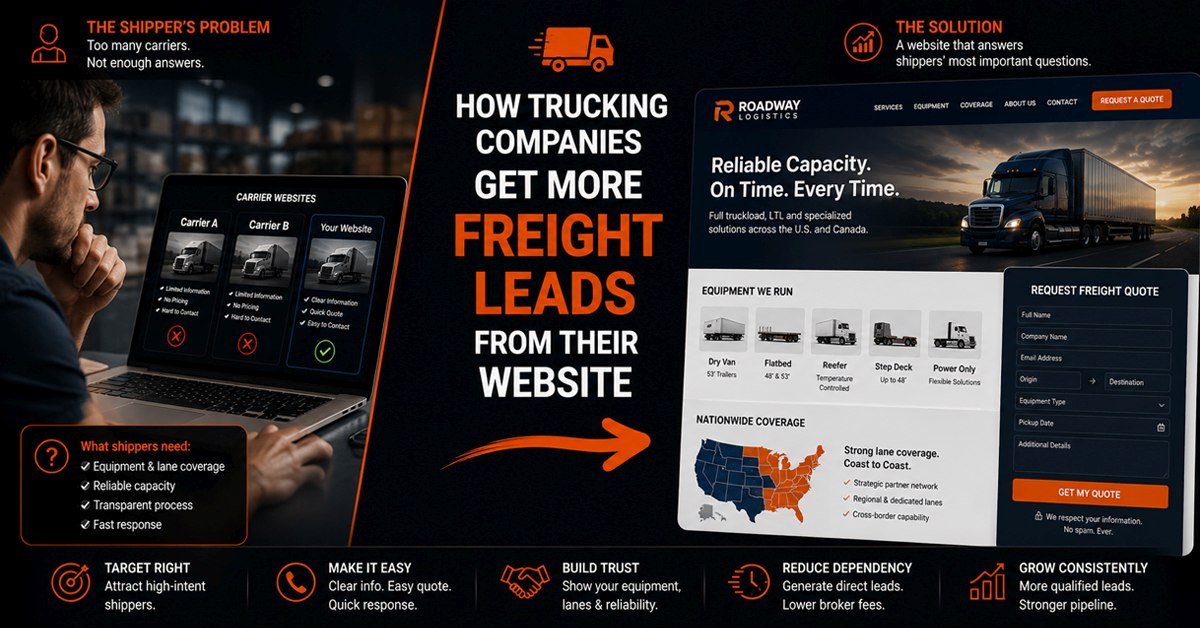
A trucking company website that generates consistent freight leads is built around one audience: the shipper evaluating whether this carrier can handle their freight. Everything else, driver recruitment, company history, equipment photos without specifications, is secondary to answering the shipper's questions quickly and giving them a clear path to request a rate.
The problem is that most trucking websites are built in the opposite order. Driver recruitment content dominates because hiring is an immediate operational pressure. The homepage hero speaks to potential employees. The services section is a paragraph. The contact form is generic. A shipper who finds the site through a freight search cannot tell within two minutes whether this carrier moves their freight type, serves their routes, or has the equipment they need. They move on to a carrier whose website does tell them.
Fixing this does not require rebuilding the entire site. It requires understanding which pages a shipper visits, what questions they are asking on each page, and what the website is currently failing to answer. That understanding is what this post is about.
The Shipper and Driver Problem: Two Audiences, One Website
A trucking company website needs to serve two completely different audiences who want completely different things. Shippers want to know whether this carrier can handle their freight, on their routes, with the right equipment, compliantly and reliably. Drivers want to know whether the job pays well, what equipment they would operate, what the home time looks like, and how to apply.
These two audiences cannot share the same pages without one of them being poorly served. A shipper reading a page built for driver recruitment finds nothing useful and leaves. A driver reading a page built for shipper acquisition finds no job information and leaves. Most trucking websites try to blend both audiences into a single homepage and a single services page, and the result is that neither gets what they need.
- Freight types and commodities handled
- Service areas, regions, and key corridors
- Equipment types, capacities, and capabilities
- DOT, MC, CSA rating, and insurance confirmation
- A structured freight inquiry form with relevant fields
- Evidence of reliability: reviews, on-time data, years operating
- Pay structure: CPM, percentage, or salary
- Home time policy and route type
- Equipment age and specifications
- Benefits, bonuses, and incentives
- How to apply and what the process looks like
- Current openings and requirements
The right architecture separates these two audiences at the navigation level. The shipper path leads through freight services, service areas, equipment capability, credentials, and a freight inquiry form. The driver path leads through current openings, pay and benefits, equipment, and an application form. Both exist on the same website. Neither has to wade through content written for the other.
Service Area and Freight Lane Pages
A trucking company whose website has no lane or service area pages is invisible in search for every route and region it operates, except the city where its main address is registered. A shipper searching for "flatbed carrier [city to city]" or "dry van trucking [state]" finds carriers who have built pages for those specific searches. A carrier without those pages does not appear in those results regardless of how much freight capacity it actually has on those routes.
Service area and freight lane pages serve two purposes simultaneously. They create search presence across the carrier's full operating territory, and they give a shipper who finds the carrier through any search enough route-specific information to decide whether to proceed. A lane page for a specific corridor should cover the freight types regularly moved on that route, the typical transit times, the equipment available for that lane, and a direct path to request a rate for that specific movement.
The quality distinction that separates a useful lane page from one that does not rank or convert is specificity. A page that says "we serve the Midwest" is not a lane page. A page that covers a specific origin-destination pair, explains what freight moves regularly on that corridor, and gives a shipper the information they need to decide whether to send a rate request is a page that earns both rankings and leads.
For carriers with many active routes, building every possible lane page is not realistic as a starting point. The right approach is to build pages for the highest-volume corridors first, the routes where the carrier has the most capacity and the most competitive rates, and then expand to secondary corridors as the cluster develops. Ten genuinely useful lane pages outperform fifty thin ones in both search and conversion.
Equipment and Freight Capability Pages
Telling a shipper you have fifty trucks tells them almost nothing about whether you can move their freight. The information a shipper needs to qualify a carrier's equipment is specific: trailer types, lengths, weight capacities, temperature ranges for reefer units, flatbed deck configurations, hazmat certifications, and any special handling capabilities. A trucking website that presents this information in a dedicated equipment and capability section gives a shipper everything they need to know whether this carrier is worth contacting for their specific load.
Why Equipment Pages Need to Be Shipper-Focused
Most trucking companies present equipment information the way they think about their own fleet: make, model, year, and a brief spec sheet. That format makes sense internally but serves shippers poorly. A shipper searching for refrigerated transport does not know or care what brand of reefer unit the carrier runs. They need to know the temperature range, the food-grade cleaning standard, whether the unit has continuous monitoring, and whether the carrier has experience with their commodity type.
A shipper evaluating a flatbed carrier wants to know maximum legal weight, overhang allowances, whether the carrier handles permit loads, and whether they have experience with the specific commodity being moved. A shipper with hazmat freight needs to see the hazmat certification class and the carrier's experience with that classification before they will consider sending a rate request.
Equipment pages built around freight capability rather than fleet specifications answer the questions a shipper is actually asking. They also create natural search presence for capability-specific queries that a generic equipment list page cannot rank for.
Carrier Credentials: DOT, MC, CSA, and FMCSA Compliance
A shipper's procurement or compliance team evaluating a new carrier checks credentials before they approve the carrier for their freight. DOT authority, MC number, FMCSA safety rating, CSA scores, and insurance levels are qualifying criteria, not supplementary information. A trucking website that makes a shipper look up these details on the FMCSA website rather than finding them on the carrier's own site has added friction at exactly the wrong moment.
The placement of credentials matters as much as their presence. Credentials buried in a footer or on a standalone compliance page that requires navigation to find are not serving the shipper who is on a service page right now deciding whether to proceed. DOT number, MC authority, and FMCSA safety rating belong on the homepage and on every service page. Insurance levels relevant to the freight types handled should be on service pages and on the freight inquiry page. CSA scores, particularly if they are strong, should be highlighted as a trust signal rather than left for shippers to look up independently.
A strong CSA score displayed prominently on a trucking website communicates something that no marketing copy can replace: that this carrier's safety performance has been independently measured and found to be above standard. Shippers who manage carrier compliance programmes know exactly what a CSA score means and weigh it heavily in carrier selection. A website that does not display it is leaving one of the strongest trust signals available unused.
The Freight Inquiry Form: What Shippers Actually Need to Provide
A generic contact form is not a freight lead generation tool. A shipper who fills out a form with their name, email, and a message about their freight is not providing the information a carrier needs to respond with a real rate. The carrier has to call back to gather the details. By the time that callback happens, the shipper has already received a rate from a carrier whose website asked the right questions upfront.
A freight inquiry form built for shippers collects the specific information a carrier needs to generate a meaningful response: origin and destination, freight type and commodity, trailer type required, weight and dimensions, pickup date or timeframe, and any special requirements such as temperature control, hazmat classification, or oversized permit needs. A shipper who can complete this form in under two minutes on a phone has given the carrier everything needed to respond with a real rate rather than a callback to gather basic information.
The form confirmation matters too. A shipper who submits a rate request and receives no immediate acknowledgment does not know whether the form worked. A confirmation that sets a specific response time expectation, "we will respond with a rate within four business hours," removes the uncertainty that causes shippers to simultaneously contact three other carriers while waiting to hear back from the first one.
Can a Trucking Website Replace Load Boards?
Not entirely, and it would not be honest to suggest otherwise. Load boards serve a real purpose for carriers who need to fill capacity quickly, especially in spot markets where the freight is available now and the carrier needs a load today. That transactional function is genuinely useful and a website does not replicate it.
What a website does that a load board cannot is build a direct shipper relationship. A shipper who finds a carrier through a load board is price-shopping in a commodity market. They compare rates from multiple carriers, choose the lowest acceptable option, and move to the next load. The carrier is interchangeable. There is no relationship, no preference, and no reason to return except on price.
A shipper who finds a carrier through their website, evaluates their service area pages, reviews their equipment capability, confirms their CSA score, and submits a rate request is doing something fundamentally different. They are selecting a carrier based on fit, not just price. When that relationship is established and the carrier performs well, the shipper returns with future loads directly, without going back to the load board. That direct repeat business is worth significantly more per load than load board freight because it carries no commission, no price pressure from competing bids, and no uncertainty about whether the capacity will be there next week.
A trucking website that generates consistent freight leads is not a replacement for load boards. It is the system that converts load board relationships into direct shipper relationships over time, and that builds a shipper base that does not need the load board to maintain.
What Most Trucking Websites Spend Too Much Space On
Understanding what to include on a trucking website that generates freight leads is also helped by understanding what does not contribute to that goal and should not dominate the space it currently occupies.
Company founding stories in the homepage hero. A shipper evaluating a carrier does not need to know the company was founded in 1987 by a retired truck driver who started with one truck. That story may be genuine and meaningful to the business. It is not the information that causes a shipper to submit a rate request. The homepage hero should answer the shipper's first question: what do you move and where?
Driver recruitment content on pages shippers visit. A page titled "Services" that begins with "We're always looking for experienced drivers" is a page built for the wrong audience. Shipper-facing pages should be entirely shipper-focused. Driver recruitment belongs in its own section with its own navigation path that a shipper never needs to encounter.
Awards and recognitions without context. A "Top Carrier 2023" badge from an industry publication tells a shipper nothing about whether this carrier can handle their freight reliably. On-time delivery percentages, damage claim rates, and years serving specific industries are evidence. Awards without context are decoration. Replace the badges with the data that actually matters to a shipper making a carrier selection decision.
Generic "we are reliable and customer-focused" language. Every carrier's website says this. It differentiates no one. The shippers who visit multiple carrier websites in a shortlisting process see this language on every site and discount it completely. Specific evidence, a CSA score, a specific commodity handled for a named industry, a service area that matches the shipper's route, is what actually differentiates one carrier from another.
What This Looks Like Across Different Trucking Operations
Websites That Generate Freight Leads vs Websites That Do Not
| Element | Website That Generates Freight Leads | Website That Does Not |
|---|---|---|
| Homepage hero | Freight types, service area, and primary action visible without scrolling. Speaks to shippers first. | Company name, tagline, and photo of a truck. No freight or route information visible without reading. |
| Service area pages | Dedicated pages per corridor and region with freight-specific content, transit information, and rate request path. | A paragraph mentioning "nationwide coverage" or a list of states with no dedicated pages. |
| Equipment information | Capability pages covering trailer types, weight limits, temperature ranges, and commodity experience. Built for shipper evaluation. | A fleet count and model year. No capability detail that helps a shipper determine fit. |
| Carrier credentials | DOT, MC, CSA score, FMCSA compliance, and insurance levels on homepage and service pages. | DOT number in the footer. CSA score not mentioned. Insurance available on request. |
| Freight inquiry form | Structured form with freight type, origin, destination, weight, equipment, and timeline. Response time stated. | Generic contact form with name, email, and message field. No structure or guidance. |
| Driver vs shipper content | Separate sections for shipper and driver audiences. Neither has to navigate through content written for the other. | Driver recruitment content on shipper-facing pages. Services and job listings mixed together. |
| Differentiation | Specific evidence: CSA score, commodity experience, on-time data, years on specific lanes. | Generic claims: "reliable," "experienced," "customer-focused." Identical to every other carrier's website. |
| Load board relationship | Website builds direct shipper relationships that reduce load board dependency over time. | Website offers nothing a load board does not. No reason for shippers to contact directly. |
When a Trucking Website Does Not Need All of This
A small owner-operator running a single truck on a consistent dedicated lane does not need eight service area pages and a structured freight inquiry form. Their capacity is full, their shipper relationship is direct, and their website is primarily a professional presence that confirms they are a legitimate operation. A simple, clean site with their DOT and MC numbers, the freight type they handle, and a phone number serves that situation well without unnecessary complexity.
The investment in lane pages, capability pages, and structured inquiry forms makes sense when the carrier is actively trying to grow its shipper base, has capacity across multiple corridors, and wants to reduce dependence on spot market load boards. The architecture scales with the ambition. A five-truck carrier building a regional book of business needs a different website than a one-truck owner-operator with a dedicated account. Both can benefit from a professional, credible web presence. The depth of the shipper-facing content should match the scale of the acquisition goal.
Frequently Asked Questions
How many service area pages does a trucking website need to generate freight leads?
The right number is the number of corridors and regions where the carrier actively operates and wants to win direct shipper business. Starting with the five to ten highest-volume lanes is more practical than trying to create pages for every possible route at once. Each page needs to be genuinely useful to a shipper researching capacity on that specific corridor, not a template with a different city name swapped in. Ten well-built lane pages that a shipper finds helpful and informative will outperform fifty thin ones in both search rankings and rate request conversions. Build the pages that match the carrier's actual capacity and geographic focus, then expand as the business grows into new corridors. Our post on how transportation companies manage client relationships through their website covers the operational layer that supports the shipper relationships these pages generate.
Should a trucking company website show freight rates?
No, and this is worth being direct about. Freight rates vary too significantly by load, lane, date, fuel conditions, and equipment availability to publish meaningfully on a website. A rate that appears on a website becomes the anchor for a negotiation the carrier did not intend to start, and a rate that is out of date creates a poor first impression when the actual quote is different. What belongs on a trucking website is the structure of how rates work for different service types, the factors that affect pricing on specific lanes, and a clear freight inquiry form that collects the information needed to generate a real rate quickly. A shipper who understands how the carrier approaches pricing and can submit a detailed rate request has a better experience than one who sees a rate on a website and then receives a different number when the actual quote comes through.
How is a trucking company website different from a general transportation website?
A trucking company website is more specific in its freight type and equipment focus than a general transportation or logistics website. A logistics provider might handle multiple modes including rail, air, and ocean freight alongside trucking. A trucking company website is built around highway freight specifically, which means the equipment pages, lane coverage, and freight inquiry forms are all oriented around truckload and less-than-truckload movements. The shipper audience for a trucking company website is also more likely to be searching for specific equipment types and corridors rather than general freight management services. The credential requirements are also specific to motor carriers: DOT, MC, CSA, and FMCSA compliance are trucking-specific regulatory frameworks that a general logistics website would not necessarily need to address. Our broader post on what every transportation and logistics website should include covers the common elements across all transportation operation types.
Is Your Trucking Website Attracting Visitors but Not Generating Freight Leads?
We review trucking and carrier websites and show you exactly what shippers are not finding before you spend anything on a rebuild or redesign.