
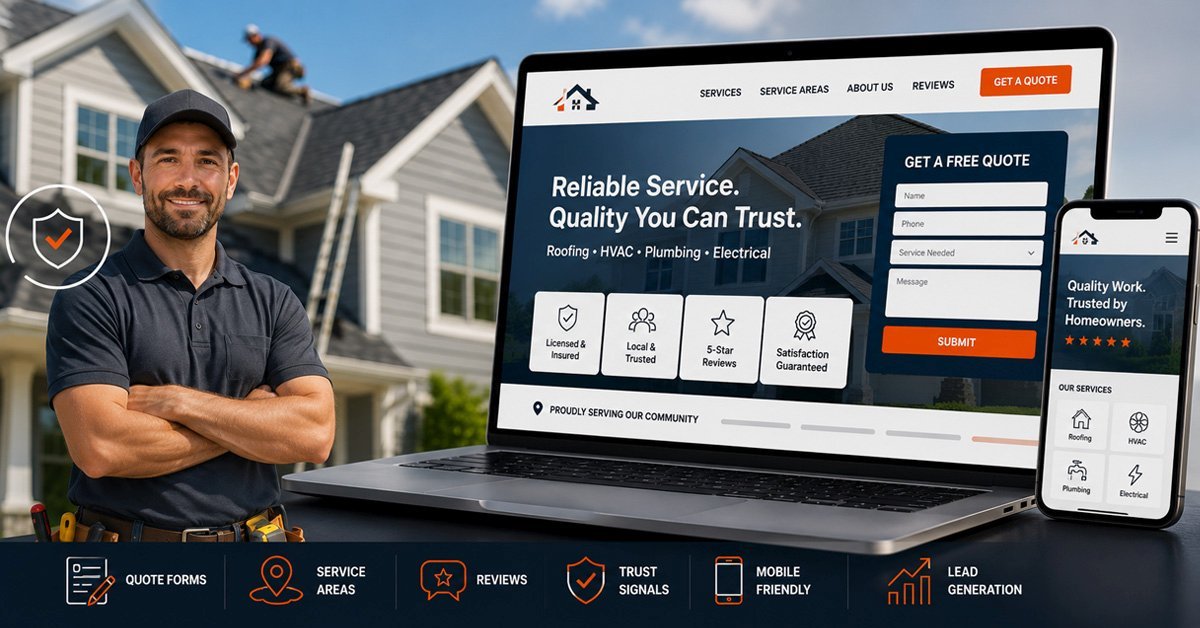
We build websites for roofing companies, HVAC contractors, plumbers, and electricians regularly, and the same gap shows up again and again when we audit an existing contractor site before a rebuild. The site looks fine. It has a logo, some service descriptions, a contact form. But it is not generating leads the way it should, and the reason is almost always the same: it was built like a generic small business website rather than a website built around how homeowners actually decide who to hire.
Home services is a trust business before it is anything else. A homeowner calling a roofer or a plumber is not comparing prices the way they would for a retail purchase. They are deciding who to let into their home and who to trust with a problem they cannot fix themselves. A contractor website that does not reflect that reality, no matter how polished it looks, will underperform.
This post covers exactly what a contractor website needs, organized by what actually influences a homeowner's decision to call.
1. A Clear Path to Contact on Every Page
This sounds obvious but it is the single most common gap we find when auditing existing contractor sites. A homeowner ready to act should never have to search for how to reach the business. The phone number and a quote request link need to be visible without scrolling, on every page, on both desktop and mobile.
The mistake we see most often is a contact form buried at the bottom of a single contact page, with no contact access from service pages, the homepage hero, or the gallery. A homeowner who just looked at a before and after roofing gallery and decided they want a quote should be able to act on that decision immediately, not navigate back to find a contact page.
2. Dedicated Pages for Each Service Offered
A single page listing "roofing, gutters, siding, and windows" in a paragraph does not give Google enough content to rank for any of those terms individually, and it does not give a homeowner researching gutter replacement specifically the depth of information they are looking for.
Each service needs its own page. A roofing company should have separate pages for roof replacement, roof repair, and roof inspection if those are distinct services they offer. Each page should describe the service, who it is for, what the process looks like, and include a clear path to request a quote for that specific service. This is both a conversion improvement and an SEO improvement, since each page can target the specific keywords homeowners search for that service.
3. Service Area Pages for Every Territory Served
Most home service searches include a location. A contractor serving a wide territory but with only one homepage is invisible in search for every city except the one tied to their main address. Service area pages solve this, but only when built correctly.
A service area page is not a city name swapped into a duplicate template. It needs genuinely useful content specific to that location: which services are offered there, any local factors relevant to the work, and a clear way to request a quote for that area. Done correctly, service area pages let a contractor compete in local search across their full territory rather than just one city.
4. A Quote Request Form That Collects the Right Information
A generic contact form asking only for name, email, and message gives the contractor very little to work with before the first call. A quote request form built around the specific trade collects the information that actually helps prioritize and prepare for that lead.
For a roofing company, this might mean asking about roof type, approximate age, and the nature of the issue. For an HVAC contractor, it might be new installation versus service call, and whether it is a heating or cooling issue. The goal is a form short enough that a homeowner completes it on their phone in under a minute, but specific enough that the contractor knows roughly what they are walking into before they call back.
5. Visible Trust Signals: Licenses, Certifications, and Guarantees
Licenses, insurance, manufacturer certifications, and satisfaction guarantees are the evidence a homeowner uses to justify trusting a contractor with their home. When this information exists only on a hidden "about us" page or not at all, the business gives up its strongest differentiators at the exact moment they would matter most.
These trust signals belong on service pages, not buried in a footer. A homeowner reading about roof replacement services should see the relevant license and insurance information right there, not have to dig for it separately. The same applies to manufacturer certifications for specific brands of equipment a contractor installs.
6. A Before and After Gallery Organized for Easy Browsing
In home services, showing the work is more persuasive than describing it. A homeowner deciding between contractors can evaluate quality directly when there is a well-organized gallery of completed projects with before and after comparisons.
The organization matters as much as the content. A gallery of fifty unfiltered photos is hard to use. A gallery organized by service type, material, or neighborhood lets a homeowner looking for examples relevant to their specific situation find them quickly. Each gallery item should link directly to the quote request form, since the moment a homeowner is impressed by a project is the moment they are most likely to convert.
7. Reviews Visible on the Website Itself
Reviews on Google or industry platforms only reach homeowners who are already searching those platforms. Reviews displayed directly on the contractor's own website reach every visitor, at the exact moment they are deciding whether to reach out.
A live review feed pulling current Google reviews is more persuasive than static testimonial copy, because it is verifiable and visibly growing over time. Star ratings and review counts displayed prominently on the homepage and service pages give homeowners the social proof they are looking for without making them leave the site to find it.
What a Contractor Website Does Not Need
Just as important as what to include is what to leave out. A contractor website does not need an overly complex design with animations that slow down mobile load times. It does not need a blog filled with generic content unrelated to the actual services offered, written purely to hit a content quota. It does not need every social media platform linked in the header competing for attention with the quote request button.
Every element on a contractor website should serve the conversion goal directly or support trust in a meaningful way. Anything that does not do one of those two things is, at best, neutral, and at worst, a distraction from the path to a quote request.
How This Comes Together: A Practical Checklist
| Element | Purpose | Common Mistake |
|---|---|---|
| Phone number and quote link | Conversion path on every page | Buried only on a contact page |
| Dedicated service pages | SEO targeting and detailed information | One page listing all services briefly |
| Service area pages | Local search visibility across territory | No pages beyond the main address city |
| Trade-specific quote form | Lead qualification before first call | Generic name and message form |
| Licenses and certifications | Trust signal at the decision moment | Hidden in footer or about page only |
| Before and after gallery | Visual proof of work quality | Unfiltered, hard to browse, or missing |
| Visible reviews | Social proof at the point of decision | Reviews only exist on external platforms |
| Fast mobile experience | Captures local, on-the-go searches | Slow loading, desktop-first design |
If you are evaluating an existing contractor website or planning a new one, this checklist covers what actually moves the needle. Our home services website development page goes deeper into how we approach building each of these elements, including the multi-location structures needed for contractors operating across several territories.
For the technical side of how these websites are built and maintained, our WordPress development service covers the platform decisions, and our WordPress maintenance service covers what keeps a contractor website running correctly after launch, since a site that loses functionality or speed over time loses the leads it was built to capture.
Frequently Asked Questions
Does a contractor website need a blog?
Not as a top priority. A blog can help with long-term SEO if maintained consistently with genuinely useful content, but it is rarely the highest-impact addition for a contractor website that is missing more fundamental elements like service area pages or a proper quote form. We generally recommend getting the core conversion elements right first, then adding a blog as a secondary content strategy once the foundation is solid.
How many service area pages should a contractor have?
This depends entirely on the actual service territory. A contractor serving five cities needs five well-built service area pages, not fifty. The goal is coverage that matches reality, with each page containing genuinely useful and unique content for that location. Creating pages for territories not actually served, or creating low-quality duplicate pages purely to increase page count, does more harm than good for both user trust and search rankings.
What is the biggest mistake contractor websites make?
The most common mistake is treating the website like a digital business card rather than a lead generation tool. This shows up as a homepage with a generic description of the business, a single contact page, and no clear path connecting a visitor's interest to an actual conversion action. The fix is reframing every page around a simple question: what does this page need to do to move a homeowner closer to requesting a quote? Pages that do not answer that question clearly are usually the ones underperforming.