
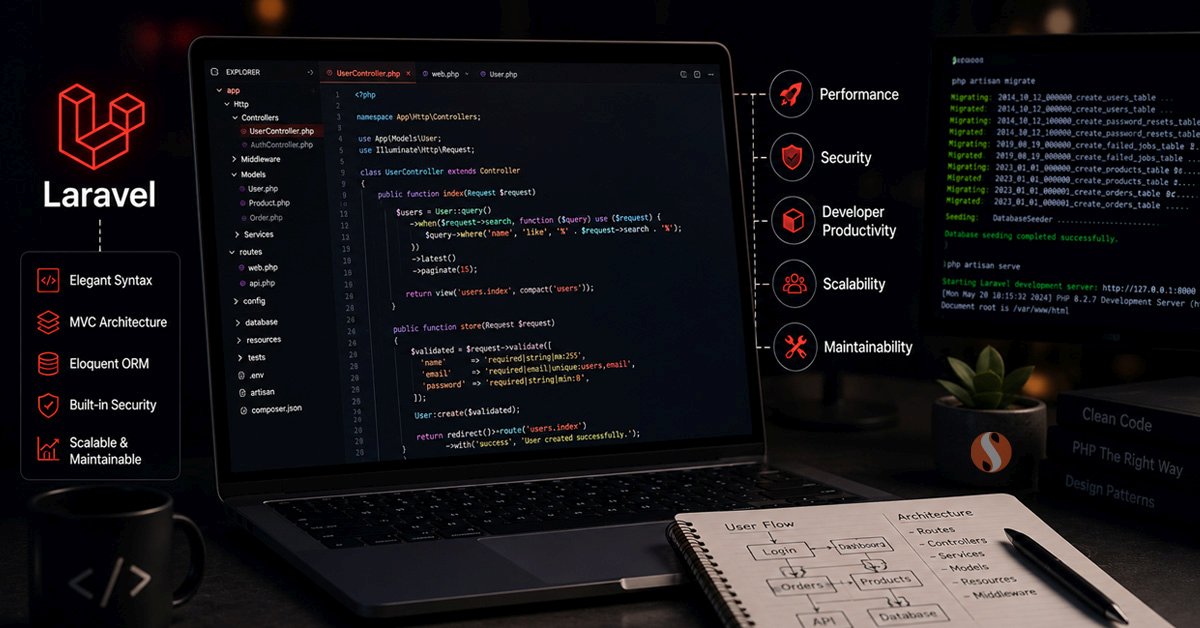
Most framework comparisons are written before anyone has built anything serious with the frameworks being compared. They list features, benchmark synthetic tasks, and reach conclusions that sound authoritative but do not reflect what it actually feels like to maintain a custom application two years after the initial build.
Laravel's reputation in the PHP ecosystem is not accidental. It has earned that reputation through specific design decisions that align well with the realities of building custom web applications for real businesses. After building Laravel applications for businesses across multiple industries worldwide, the pattern is clear: the framework reduces friction at exactly the points where custom development tends to slow down, cost more, and break in ways that are hard to diagnose. This post covers what those decisions are, why they matter in practice, and the specific situations where Laravel is the right tool.
What Laravel Actually Gets Right
Before covering specific features, it is worth establishing what "works well" actually means in the context of custom application development. A framework works well when it reduces the friction between having a requirement and implementing it correctly. When it makes the right way to do something also the easy way. When an application built with it six months ago can be picked up and extended by a different developer without significant orientation time. Laravel consistently delivers on all three of those criteria.
Where Laravel Pulls Ahead of the Alternatives
PHP has other frameworks and the PHP ecosystem also competes with Node.js, Python, and Ruby for custom application development work. The comparison is worth being specific about.
| What matters in practice | Laravel | Symfony | Node.js / Express | Django |
|---|---|---|---|---|
| Developer onboarding speed | Fast | Steep curve | Moderate | Moderate |
| Built-in features out of the box | Comprehensive | Component-based | Minimal, assemble yourself | Comprehensive |
| ORM quality | Eloquent, excellent | Doctrine, powerful but verbose | Varies by choice | Django ORM, excellent |
| Background job handling | Built in, polished | Messenger component | Third party required | Celery, separate setup |
| WordPress and WooCommerce integration | Natural PHP ecosystem fit | Possible but uncommon | API only | API only |
| Hosting availability and cost | PHP hosting is widespread | Same as Laravel | Needs Node-capable hosting | Python hosting less common |
| Long-term maintainability | Strong conventions, readable | Strong but more complex | Highly variable by team | Good but Python-specific |
The comparison against Node.js and Express deserves particular attention. Node.js is genuinely excellent for real-time applications, WebSocket servers, and services where a large number of concurrent connections need to be handled with minimal memory overhead. For those specific scenarios it is often the right choice.
For most custom business applications, the Node.js advantage does not apply. A booking system, a client portal, a custom inventory management tool, or a complex API backend does not need real-time concurrency handling. It needs a well-structured codebase, reliable database interaction, good authentication, and enough built-in tooling that the development team is not assembling infrastructure from scratch before writing business logic. Laravel provides all of that. Express provides almost none of it by default, and the cost of that assembly work is consistently underestimated in project briefs.
The Specific Project Types Where Laravel Fits Best
Laravel and WordPress: How They Work Together
This is one of the questions we get most often from businesses that already have a WordPress site and are evaluating whether they need a custom application. The answer is almost never one or the other. It is both, working together through a clean API boundary.
The diagram above represents the architecture we reach for when a business has outgrown what WordPress alone can handle cleanly but does not want to abandon the content management and ecommerce investment already in place. WordPress continues doing what it does best. Laravel takes on the parts of the system that need custom data modelling, complex integrations, or background processing that WordPress was not designed for. The two communicate through well-defined API boundaries.
What Laravel Does Not Do Well
An honest assessment includes the situations where Laravel is not the right choice. Understanding those boundaries is as useful as understanding the strengths.
Laravel is not the right tool for a standard business website or blog. A company that needs a fast, manageable website with a content editor that non-technical staff can use does not need a custom Laravel application. They need WordPress, built properly. The overhead of a Laravel application, both in development time and in ongoing hosting requirements, is not justified when WordPress handles the actual requirements cleanly. We turn down Laravel projects regularly when the honest answer is that a well-built WordPress site would serve the client better at lower cost.
Laravel is also not ideal for very small, single-purpose utilities that need to be deployed quickly and maintained by a single person. For those scenarios, the framework's structure adds more overhead than it saves.
The Maintenance Reality After Launch
One of the most underappreciated aspects of choosing a framework is what happens 18 months after launch when the original developer is no longer available and the application needs to be extended or fixed. This is where Laravel's conventions pay off most clearly.
A Laravel application built by a competent developer follows predictable patterns. Controllers live in a specific place. Models define their relationships in a consistent way. Business logic is separated from presentation. Database changes are captured in migrations. We have taken over Laravel applications built by other teams and oriented ourselves within hours rather than days, specifically because the framework enforces enough structure that there is limited room for idiosyncratic decisions that only the original developer understands.
The Sentinel Infotech team, based in India, has built and maintained Laravel applications for businesses across multiple industries worldwide. The consistent pattern across those projects is that well-structured Laravel codebases remain maintainable and extensible years after the initial build. That longevity is ultimately what makes the framework worth the investment for projects with real complexity. Our Laravel development service is built on exactly that kind of long-term thinking, combined with deep WordPress and WooCommerce development experience that informs when Laravel is genuinely the right answer and when it is not.
Common Questions About Laravel and WordPress
Is Laravel better than WordPress?
They are not directly comparable because they solve different problems. WordPress is a content management system designed for websites, blogs, and ecommerce stores. Laravel is a PHP framework designed for building custom web applications with complex business logic. Asking which is better is like asking whether a screwdriver is better than a hammer. The right tool depends entirely on what you are building. For a business website or an online store, WordPress is almost always the faster, more cost-effective choice. For a custom application with complex data models, user roles, background processing, or external system integrations, Laravel is the better foundation. Many projects use both together, with WordPress managing content and a Laravel application handling the custom business processes that WordPress was not designed for.
When should I choose Laravel instead of WordPress?
Choose Laravel when your project has requirements that exceed what WordPress handles cleanly. Specifically: when you need custom user roles and permissions beyond what WordPress plugins provide, when you need complex data relationships that do not map well to the WordPress post and metadata structure, when you need background processing for tasks like report generation, email campaigns, or external API synchronisation, when you are building a multi-tenant application where multiple businesses each need isolated data environments, or when you are building an API backend that will serve a React frontend, a mobile app, or third-party integrations. If your project is primarily a website with some custom functionality added, WordPress is the better starting point. If your project is primarily an application that happens to have a web interface, Laravel is the better starting point.
Can Laravel and WordPress work together?
Yes, and this is actually one of the most effective architectures for businesses that have outgrown what WordPress alone can handle. WordPress manages content, blog posts, and ecommerce through WooCommerce. A Laravel application sits alongside it handling the business processes that need custom logic, such as a booking engine, a supplier integration, a client portal, or a reporting dashboard. The two applications communicate through the WordPress REST API where needed, and users experience them as part of the same system. This approach lets you keep the content management and ecommerce investment already in place while adding genuinely custom application capability where the business actually needs it. Authentication can be shared between the two applications so users do not need separate logins.